You’ve done the work. You’ve sat in the therapist’s chair. You’ve read the books, filled out the worksheets, learned to “reframe” your thoughts, identified your “parts,” practiced the breathing exercises. You can explain your childhood trauma better than most licensed clinicians.
And you still feel stuck.
Not stuck like you haven’t tried. Stuck like you’ve tried everything and you’re starting to wonder if maybe you’re the problem. Maybe you’re just too damaged. Too far gone. Maybe everyone else gets better and you’re the one person who can’t.
That voice — the one telling you that right now — isn’t the truth. It’s your shame talking. And the reason you still feel stuck after all that work is not because you’re broken. It’s because every approach you’ve tried has been working around the two things that actually keep you trapped: shame and denial.
No one taught you how to confront them directly. Not because they didn’t care but because most frameworks aren’t built to go there.
This article is going to show you why. And it’s going to show you what actually works — not because I said so, but because the neuroscience backs it up.
The Pattern You’re Ashamed Of (But Can’t Seem to Stop)
You know the feeling. Something triggers you — a tone of voice, a perceived rejection, a moment where you felt unseen — and before you can catch yourself, you’re gone. You’re reactive. You’re shutting down. You’re people-pleasing. You’re rage-texting. You’re dissecting a three-sentence conversation for the next six hours.
And then the shame hits. Why did I do that again? I know better than this. What is wrong with me?
What You Do
You overfunction. Or you collapse. Or you perform calm while your nervous system screams. You rehearse conversations in the shower. You say “I’m fine” while your chest is on fire. You feel five years old trying to negotiate an adult relationship.
What Your Body Tells You
Tight throat. Clenched jaw. Heat in your chest. Heaviness in your stomach. That frozen, hollow feeling where you can’t access any words — or the opposite, where the words pour out and you can’t stop them. Your body remembers what your mind has filed away.
What Your Blueprint Decided
Your Emotional Blueprint — the subconscious programming installed in childhood that governs how you think, feel, and react in every relationship.
Somewhere in childhood, your emotional blueprint wrote a rule: Love means I have to perform. Safety means I can’t have needs. Belonging means I abandon myself. That rule is still running. Every reaction you’re ashamed of is that program executing on schedule.
You’re not broken. You’re programmed. And you’ve been trying to fix the program with tools that can’t reach it.
What’s Really Going On Underneath: Your Emotional Blueprint and the Worst Day Cycle
Here’s what nobody told you in therapy: the pattern you can’t stop isn’t a behavior problem. It’s not a thinking problem. It’s a blueprint problem.
Your emotional blueprint was installed in childhood — before you had language, before you had logic, before you had any capacity to evaluate whether the rules being written were true or fair. Your brain absorbed the emotional environment you grew up in and created automatic programs to keep you safe within it.
How the Worst Day Cycle Keeps the Program Running
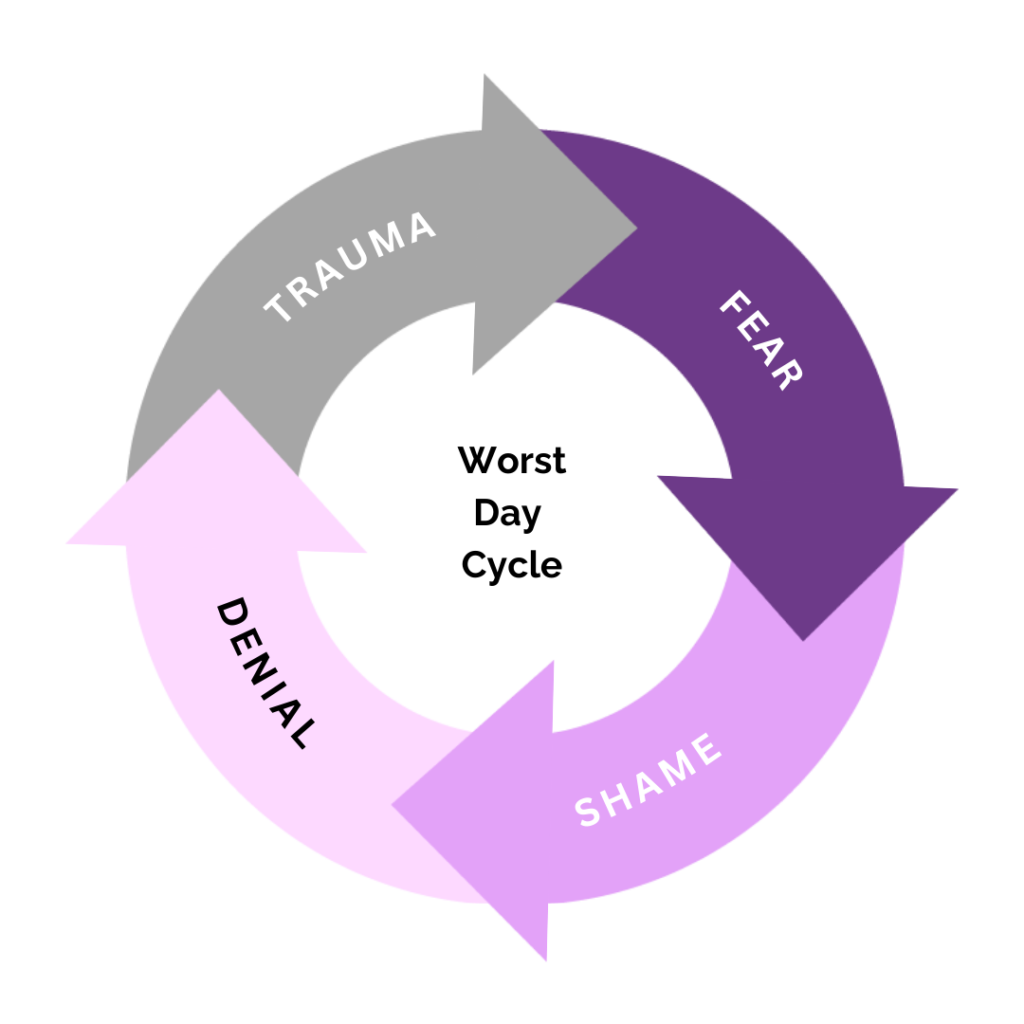
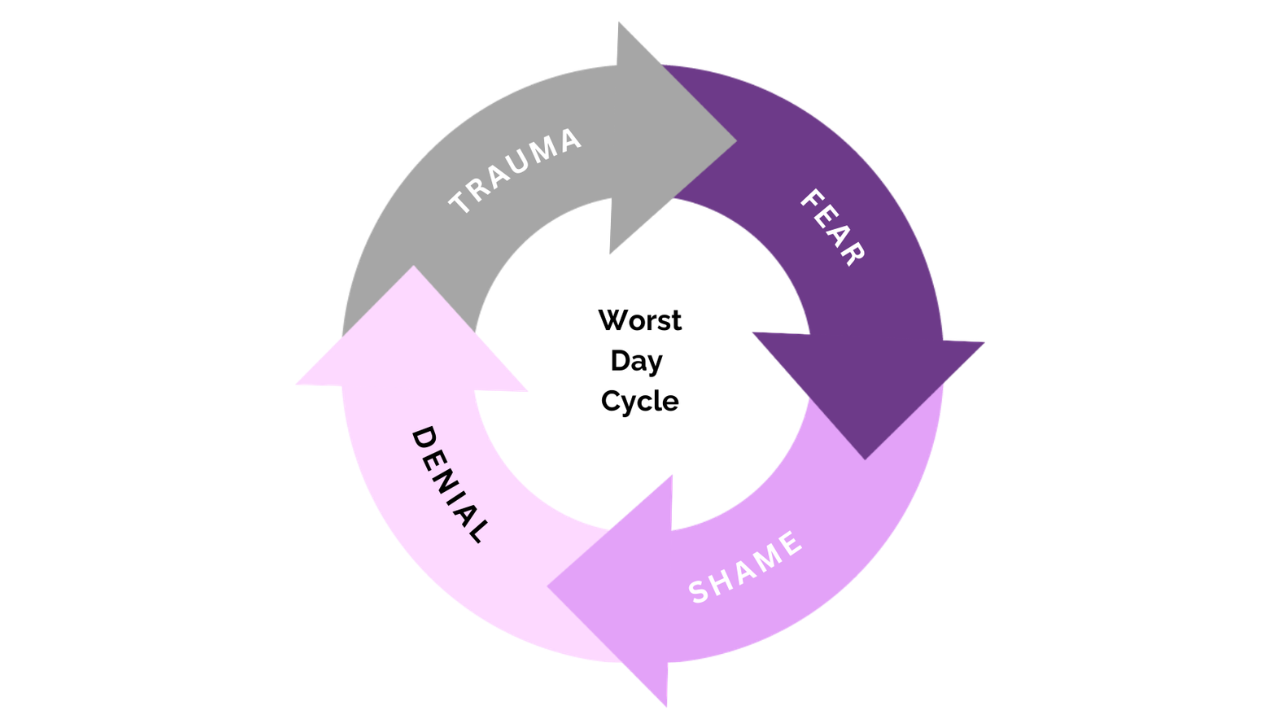
The Worst Day Cycle™ — Trauma → Fear → Shame → Denial. The engine underneath every repeating emotional pattern.
Something happened to you. It created fear. That fear crystallized into shame — the deep, wordless belief that something is fundamentally wrong with you, not with what happened. And because shame is unbearable, your brain created denial and self-deception to keep you from having to feel it.
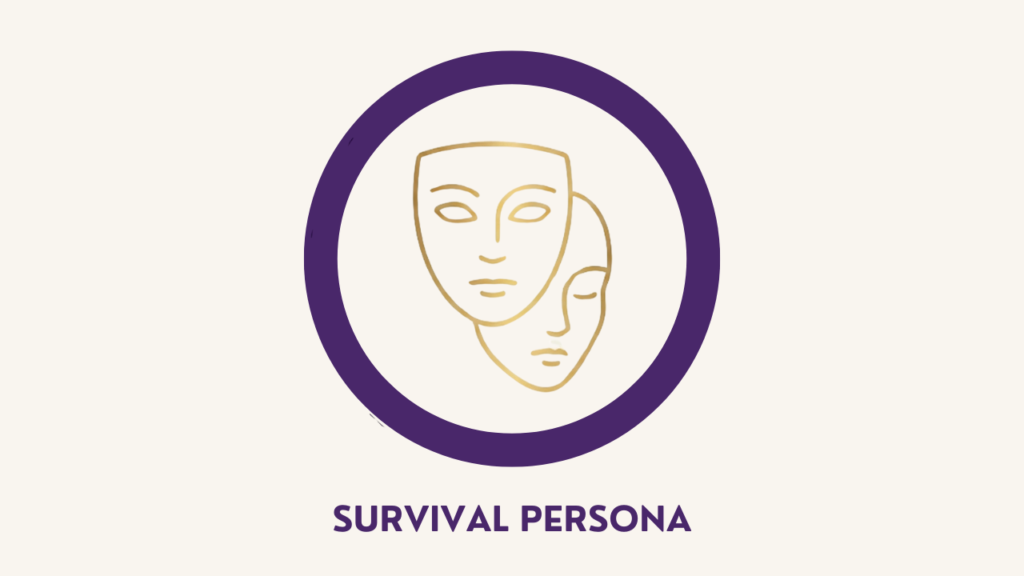
This is what some call your ego or your shadow. It’s the mask your brain built in childhood to protect you from the pain shame creates.
The Survival Persona
The Survival Persona — what others call the ego or the shadow. The mask your brain created to protect you from shame. It distorts reality through denial and self-deception.
Your Survival Persona isn’t a villain. It kept you alive. But it was built by a child, for a child’s world. And now it’s running your adult life — your relationships, your career, your parenting, your self-worth — using rules that were never true and strategies that no longer serve you.
And here’s the devastating part: every framework you’ve tried has been bumping up against this cycle without naming it. They’ve been trying to change your thoughts, regulate your nervous system, or re-parent your inner child — all while shame and denial sat untouched underneath, quietly running the show.
Why CBT, IFS, Talk Therapy, and Self-Help Books Haven’t Gotten You Unstuck
This isn’t about bashing other approaches. Many of them have value. But if you’ve invested years in therapy, coaching, or personal development and you’re still cycling through the same patterns, you deserve to understand why — so you can stop blaming yourself for something that was never your fault.
Why CBT Falls Short for Childhood Trauma Recovery
Cognitive Behavioral Therapy is the most widely recommended therapeutic approach in the world. It works by identifying negative thought patterns and replacing them with healthier ones. For mild anxiety and situational depression, it can be genuinely helpful.
But here’s the problem: CBT assumes you can think your way to change. And trauma doesn’t live in your thoughts — it lives in your body, your nervous system, and your subconscious emotional blueprints. Research published in the National Institutes of Health shows that CBT nonresponse rates for PTSD can be as high as 50%. That means half the people going through the gold-standard treatment aren’t getting better.
Why? Because CBT targets the content of your thoughts without addressing the subconscious programming that generates those thoughts. It’s like trying to fix a software glitch by editing what’s on the screen instead of rewriting the code.
Why IFS Parts Work Can Create More Fragmentation, Not Less
Internal Family Systems therapy has exploded in popularity. It breaks your psyche into “parts” — managers, firefighters, and exiles — and teaches you to have conversations with them. For some people, this offers initial relief and a useful language for their inner experience.
But there are serious concerns. The Society for the Advancement of Psychotherapy has noted that IFS has a strikingly small evidence base despite being developed over 30 years ago, and there are documented cases of it exacerbating splitting of self-states.
Think about that for a moment. A framework designed to help you heal can actually make you more fragmented. More dependent on the model. More disconnected from a unified sense of who you are.
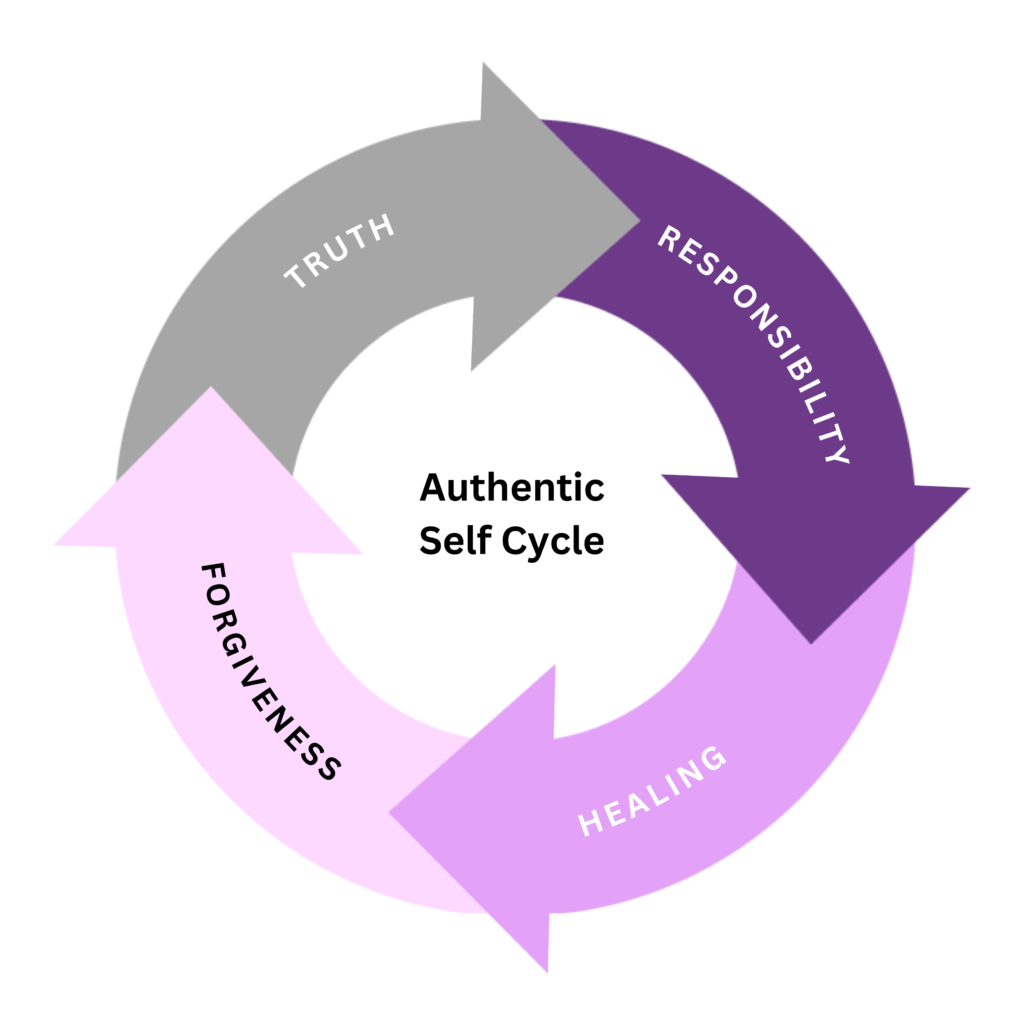
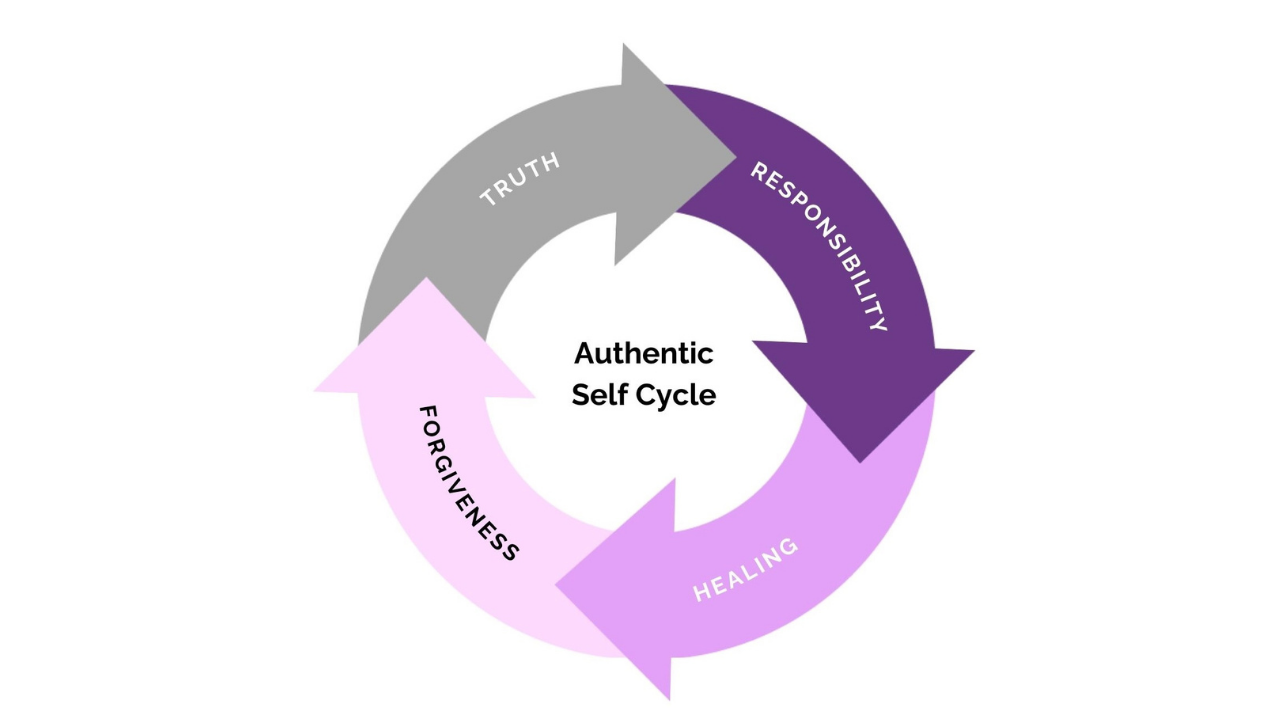
The Authentic Self Cycle does the exact opposite. Instead of breaking you into parts and negotiating between them, it builds a single, integrated pathway: Truth → Responsibility → Healing → Forgiveness. You don’t need a therapist to “talk to your parts.” You develop the capacity to observe, own, and rewrite your own programming.
Why Talk Therapy Keeps You Comfortable but Doesn’t Change You
Traditional talk therapy can provide validation, insight, and a safe relationship — all of which matter. But validation without confrontation is comfort without change. If your therapist never challenges your denial, never names your shame, never asks you to take ownership of the patterns you’re running — you’ll feel heard, but you won’t heal.
You can spend a decade in therapy learning why you are the way you are, without ever changing how you are. That’s not a failure of effort. That’s a failure of framework.
The Emotional Authenticity Shift: What Actually Rewires Your Brain
Emotional Authenticity™ — The metacognitive practice that activates your anterior prefrontal cortex to interrupt subconscious emotional blueprints at the root.
Emotional Authenticity activates metacognition — the highest form of human intelligence. When you practice it, you engage your anterior prefrontal cortex, the part of your brain that isn’t designed for action or emotion. It’s designed for self-observation.
This is not mindfulness. This is not meditation. This is not “being present.” This is a directed, specific neurological process that allows you to turn your attention inward and interrupt the automatic, subconscious emotional blueprints that have been running your life without your permission.
You’re Using Your Brain’s Hardware to Edit Its Own Software
Neuroscience research confirms that metacognitive practice supports neuroplasticity — the brain’s ability to rewire itself in response to experience. Over time, repeated metacognitive practice strengthens new neural pathways that support clarity, calm, and resilience.
But Emotional Authenticity doesn’t just build general awareness. It aims that awareness at the two specific forces that block all real change:
Shame — the invisible weight you’ve been carrying since childhood
Denial and self-deception — what some call your ego or your shadow — the part of you that distorts reality to avoid the pain shame creates
The Three Questions That Change Everything
Emotional Authenticity asks three deceptively simple questions:
What am I feeling right now?
Where in my body do I feel it?
What is my earliest memory of having this feeling?
These questions bypass your intellect and go straight to the blueprint. They activate the anterior prefrontal cortex for self-observation while simultaneously connecting you to the somatic and emotional data your subconscious has been hiding from you.
That third question — what is my earliest memory of having this feeling? — is the one that most frameworks are too afraid to ask. Because the answer always leads to childhood. It always leads to the wound. And it always leads to shame.
And that’s exactly where you need to go.
The Authentic Self Cycle: The Pathway That Replaces the Pattern
Once Emotional Authenticity creates recognition — once you see the blueprint, feel it in your body, and trace it to its origin — the Authentic Self Cycle gives you a pathway forward:
The Authentic Self Cycle™ — Truth → Responsibility → Healing → Forgiveness. The integrated pathway that replaces the Worst Day Cycle and gives you somewhere to go once Emotional Authenticity reveals what’s been running underneath.
Truth means looking at yourself honestly and owning your part. Not to punish yourself — but to stop defending what isn’t working.
Responsibility means accepting your failures and your perfect imperfections without shame. It means choosing to stop running from the pattern and start owning it.
Healing becomes possible because you’ve stopped fighting reality. You’ve stopped letting denial protect you from the very thing you need to confront.
And forgiveness doesn’t have to be forced. When truth, responsibility, and healing are present, forgiveness arrives naturally — because you’ve finally earned it from the only person whose forgiveness ever mattered: yourself.
What This Looks Like in Real Life
Before Emotional Authenticity
Your partner says something dismissive at dinner. Within seconds, your chest tightens. Your jaw locks. You either shut down completely or launch into a counterattack you’ll regret by midnight. Later, alone, you replay the conversation for hours — finally thinking of what you wish you’d said. You tell yourself you overreacted. You feel ashamed. You promise yourself you’ll “do better next time.” The cycle continues.
After Emotional Authenticity
Your partner says the same thing. Your chest tightens. But this time, you notice it. What am I feeling? Rejected. Unseen. Where do I feel it? My chest. My throat. What’s my earliest memory of this feeling?
And there it is. You’re not reacting to your partner. You’re reacting to a six-year-old wound that just got activated. The blueprint fired. But for the first time, you caught it while it was running instead of after the damage was done.
That pause — that moment of metacognitive self-observation — is everything. It’s the moment where the old software stops running and the new programming begins.
Why This Combination Outperforms Every Other Trauma Recovery Framework
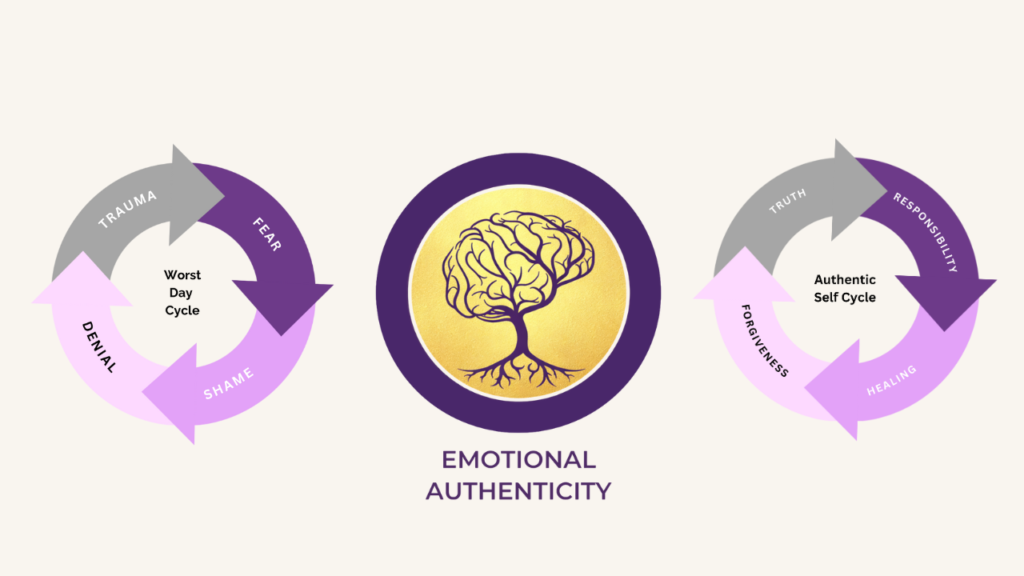
The complete system: Emotional Authenticity bridges the Worst Day Cycle™ (Trauma → Fear → Shame → Denial) to the Authentic Self Cycle™ (Truth → Responsibility → Healing → Forgiveness).
No single framework in the current trauma recovery landscape combines all of the following elements. This is what makes Emotional Authenticity and the Authentic Self Cycle fundamentally different:
It Activates the Right Part of the Brain CBT targets the cognitive functions. Somatic work targets the body. Emotional Authenticity targets the anterior prefrontal cortex — the brain region specifically designed for self-observation, not action or emotion.
It Confronts the Two Actual Blockers of All Change Shame and denial are not symptoms. They are the gatekeepers of every pattern you can’t break. Emotional Authenticity confronts both head-on.
It Builds Integration Instead of Fragmentation IFS breaks you into parts. Emotional Authenticity builds you into a whole. The Authentic Self Cycle creates a unified pathway that strengthens your capacity to lead your own internal system.
It Leverages Neuroplasticity Through Directed Metacognition You’re not just observing — you’re observing the exact thing your brain is designed to hide from you.
It Follows the Brain’s Natural Learning Sequence Emotional Authenticity leads with recognition — creating the “that’s me” moment that activates the anterior prefrontal cortex before teaching lands.
It Provides a Complete, Sequential System — Not Just a Technique A repeatable, sequential process that works whether you’re dealing with relationship patterns, career self-sabotage, parenting triggers, or childhood shame.
Frequently Asked Questions
Why does therapy not work for childhood trauma?
Many traditional therapy approaches focus on changing thoughts or managing symptoms without addressing the subconscious emotional blueprints installed in childhood. These blueprints operate beneath conscious awareness, driven by shame and denial — two forces that most therapeutic models work around rather than confront directly.
What’s the difference between CBT and Emotional Authenticity for trauma?
CBT tries to replace negative thoughts with healthier ones. Emotional Authenticity doesn’t try to change your thoughts at all — it activates the anterior prefrontal cortex for self-observation, allowing you to interrupt the subconscious programs that generate those thoughts.
Is IFS therapy effective for trauma recovery?
IFS can offer initial relief and useful language for inner experience. However, the evidence base remains limited, and clinical observers have noted that parts work can create fragmentation rather than integration. The Authentic Self Cycle takes the opposite approach.
How does metacognition help heal trauma?
Metacognition activates the brain region designed for self-observation rather than reaction. This supports neuroplasticity — the brain’s ability to rewire itself. Emotional Authenticity uses directed metacognition aimed specifically at shame and denial.
Why do I keep repeating the same patterns even after years of personal development?
Because the pattern isn’t a behavior problem or a thinking problem — it’s a blueprint problem. The Worst Day Cycle keeps running beneath conscious awareness. Until you confront shame and denial directly, every other intervention will only address the surface.
Your Next Small Step
You don’t have to overhaul your life today. You don’t have to sign up for anything or commit to a program. You just have to try one thing.
The next time you feel triggered — the next time your chest tightens, your throat closes, or you hear that familiar inner voice telling you you’re not enough — pause. And ask yourself three questions:
What am I feeling right now?
Where in my body do I feel it?
What is my earliest memory of having this feeling?
You don’t have to do anything with the answer. Just notice it. That’s Emotional Authenticity. That’s your anterior prefrontal cortex coming online. That’s the moment the old software pauses and the new programming has a chance to begin.
One moment of directed self-observation. That’s all it takes to start interrupting decades of automatic programming.
When You’re Ready to Go Deeper
If something in this article made you think “Oh my God, that’s me” — that recognition is the beginning. Not the end.
Kenny Weiss has spent decades developing the Emotional Authenticity Method™, the Worst Day Cycle™, and the Authentic Self Cycle™ into a complete system for people who’ve tried everything and still feel stuck. His two books — Your Journey to Success and Your Journey to Being Yourself — go deeper into these frameworks. His courses at The Greatness U walk you through the full process, from recognition to rewiring.
You’re not broken. You were never broken. You were programmed — and now you have a framework that can actually reach the programming.
Your authentic self has been waiting. It’s time to hear it.
You are going about your day, everything is fine, and then boom—one text message, one passive-aggressive comment from your partner, or one mistake at work, and you are instantly spiraling. Your heart races, your mind catastrophizes, and before you know it, your entire day is ruined.
An emotional spiral is a rapid, involuntary escalation of fear, shame, or anxiety triggered by a present-day event that activates your childhood emotional blueprint—the unconscious programming your nervous system built in childhood to survive painful experiences. Emotional spirals are not a sign of weakness or sensitivity. They are biochemical events driven by trauma chemistry, and they cannot be stopped with logic, willpower, or deep breathing once the limbic hijack has already fired.
You spend hours, or even days, playing defense against your own mind. You try to use logic to calm down, you try to distract yourself, but the spiral just pulls you deeper into anxiety, frustration, or shame. You feel exhausted because you are constantly reacting to your triggers instead of controlling them.
If this is you, I want you to know that you are not broken, and you are not “too sensitive.” You are simply trapped in a reactive emotional loop, relying on an outdated childhood emotional blueprint.
That’s you… wondering why you can manage a million-dollar budget at work but can’t manage a passive-aggressive text from your mother without falling apart.
Here is why waiting until you are triggered to use your coping skills is a recipe for failure, how the Five-Step Change Process rewires your neural pathways, and the proactive framework you need to stop the spiral before it even starts.
TL;DR: You cannot stop an emotional spiral once your limbic system has been hijacked—your prefrontal cortex is already offline. The solution is proactive emotional regulation: training your nervous system before the trigger hits using the Emotional Authenticity Method™, the Three Unstuck Questions, and the Five-Step Change Process to rewire your childhood emotional blueprint at the root.
How Does the Five-Step Change Process Rewire Your Brain and Stop Spirals?
Let’s start with a massive paradigm shift. Most people only think about emotional regulation after they have already been hijacked by a trigger. That is like trying to put on your seatbelt after you have already crashed the car.
When you get triggered, your brain experiences a limbic hijack. Your prefrontal cortex—your logic center—shuts down, and your adapted wounded child takes the wheel, running on your outdated emotional blueprint.
That’s you… sitting in the parking lot after a meeting, hands shaking, rehearsing what you should have said, while the shame chemicals flood your body like you’re six years old again.
The Worst Day Cycle™ explains exactly why spirals happen: Trauma creates Fear, Fear creates Shame, Shame creates Denial, and Denial keeps you looping back into Trauma. Your emotional spiral is this cycle firing in real time. The trigger is never really about today—it is about the unresolved childhood wound that today’s event just activated.
To stop the spiral, you have to understand the Five-Step Change Process of rewiring a neural pathway:
Step 1: The limbic hijack happens, you respond with your usual spiral, and hours later you realize you didn’t use any emotional regulation tools.
Step 2: The hijack happens, you consider using new tools, but you don’t want to let the anger or anxiety go because it feels familiar, so you repeat the old pattern.
Step 3 (The Hardest Step): The hijack happens, you consider the tools, but you actively choose to stay angry or anxious because letting go feels like losing connection to your survival persona.
Step 4: You remember your tools and try partial aspects of them, but don’t fully embrace them.
Step 5: The emotional hijack happens, you use your Emotional Authenticity skills completely, and they work. For the first time, your emotional chemistry proves you can survive without your survival persona.
That’s you… stuck at Step 3 for the thousandth time, knowing exactly what you should do but choosing the familiar pain anyway because at least it feels like control.
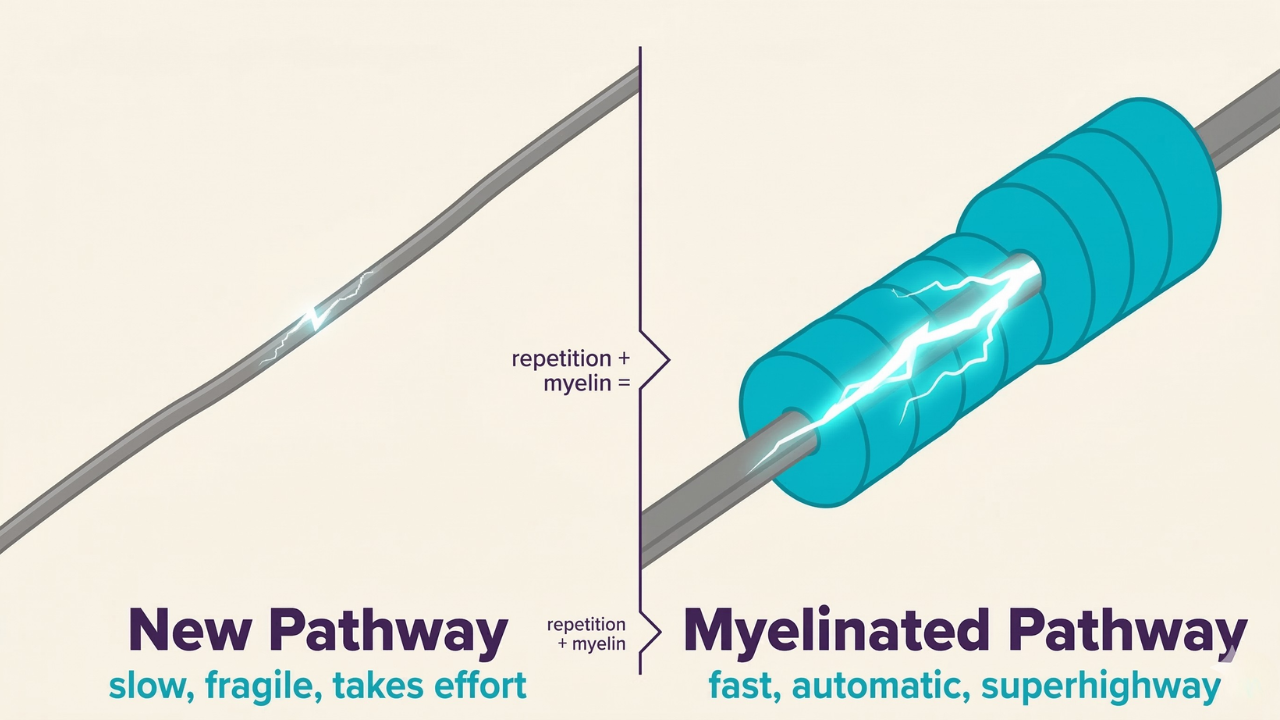
Each time you practice these steps, you are laying down myelin—the biological insulation that strengthens neural pathways. The more you practice, the faster and more automatic the new pathway becomes. This is not a metaphor. This is neuroscience. Your brain physically rewires when you repeat a new emotional pattern.
Why Does Your Brain Hold Onto the Spiral Instead of Letting Go?
Why is it so hard to stop a spiral once it starts? Why do we get stuck in Step 3 of the change process, where we actually choose to stay angry, panicked, or victimized?
It is because your spiral gives you a disempowering benefit. When you catastrophize or rage, it gives your brain a sense of certainty. Your brain would rather experience familiar pain than unfamiliar peace.
That’s you… knowing the anxiety is irrational but holding onto it anyway because calm feels more dangerous than chaos.
When you were a child, your brilliantly adaptive brain created a survival persona to protect you from the unhealed pain and shame your perfectly imperfect parents transferred into you. Your anger, your anxiety, and your spirals are the adapted wounded child’s connection to the person who dumped that shame into you. To let go of the spiral feels like losing that connection.
There are three survival persona types, and each one spirals differently:
The Falsely Empowered persona spirals into rage, control, and dominance. When triggered, this person attacks—verbally, emotionally, or through withdrawal as punishment. The spiral sounds like: “How dare they treat me this way? I’ll show them.” Underneath the rage is terror—terror of being vulnerable, of being seen as weak, of being the powerless child they once were.
That’s you… slamming the door and giving the silent treatment for three days, telling yourself they deserve it, while the shame underneath grows heavier with every hour.
The Disempowered persona spirals into collapse, people-pleasing, and self-abandonment. When triggered, this person folds—apologizing for things that aren’t their fault, over-explaining, desperately trying to make the other person happy. The spiral sounds like: “What did I do wrong? How do I fix this? Please don’t leave.” Underneath the collapse is the same terror—terror of abandonment, of being too much, of being the burden their childhood told them they were.
That’s you… drafting and deleting the same text seventeen times because you’re terrified of saying the wrong thing and losing them forever.
The Adapted Wounded Child oscillates between both. One moment raging, the next moment collapsing. One day setting a boundary, the next day apologizing for having needs at all. This is the most exhausting spiral because you never know which version of yourself is going to show up.
That’s you… screaming at your partner at dinner and then crying in the bathroom twenty minutes later, wondering which reaction was the “real” you.
This is why, when you are in the middle of a spiral, your body physically tenses up. Your survival persona is holding on for dear life because it developed this character to survive. Proactive regulation means recognizing this tension early and realizing that letting go of the spiral is not a loss of safety; it is the ultimate return to your Authentic Self.
Your brain is not choosing chaos because it is broken. It is choosing chaos because it is addicted to the trauma chemistry—the cortisol, adrenaline, and dopamine cocktail that your hypothalamus has been producing since childhood. Your spiral is a chemical event, not a character flaw. And chemical events require biochemical solutions, not just better thoughts.
What Do Emotional Spirals Look Like Across Your Entire Life?
Emotional spirals do not stay in one lane. They bleed into every area of your life, and most people do not connect the dots because the spiral looks different depending on the context.
In Family: One phone call from your parent and your entire week is derailed. You replay the conversation obsessively, oscillating between anger and guilt. You cancel plans because you are too emotionally drained. You snap at your kids for minor infractions because your nervous system is already maxed out from the call you had three hours ago.
That’s you… telling yourself “I’m over it” while your jaw is clenched so tight you can feel it in your temples.
In Romantic Relationships: Your partner says something slightly dismissive and your brain treats it like a five-alarm fire. You withdraw, or you interrogate. You need reassurance but asking for it feels like weakness, so you test them instead. The spiral convinces you that this relationship is ending, that you are not enough, that they are going to leave—all because they didn’t text back within twenty minutes.
That’s you… checking their location for the fourth time because the silence feels exactly like the silence before your parents’ divorce.
In Friendships: You overcommit and then resent everyone for needing you. Or you isolate completely because social interactions leave you so depleted you need two days to recover. You convince yourself that nobody really wants you around—they just tolerate you. The spiral turns a missed invitation into proof that you are fundamentally unlovable.
In Work and Career: One critical email from your boss and you are convinced you are about to be fired. You overwork to compensate, burning yourself out to prove your worth. Or you freeze—avoiding the project, the email, the conversation—because the shame of imperfection is worse than the consequence of procrastination.
That’s you… staying up until 2am perfecting a presentation that was already good enough because “good enough” triggers the same shame you felt when your report card wasn’t perfect.
In Body and Health: Chronic tension in your jaw, shoulders, or gut. Stress eating or not eating at all. Insomnia because your mind won’t stop running worst-case scenarios at 3am. Your body is keeping the score of every spiral your mind refuses to process.
Why Do Coping Skills, Deep Breathing, and Even Therapy Fail to Stop Emotional Spirals?
You have tried everything. Box breathing. Journaling. Cognitive reframing. Positive affirmations. Maybe even years of therapy where you understand your patterns intellectually but still cannot stop them from running your life.
Here is why none of it worked: every one of those tools is designed to be used after you are already triggered. They are reactive tools for a proactive problem. And once your limbic system has fired, your prefrontal cortex—the part of your brain that would use those tools—is already offline.
That’s you… knowing every coping skill in the book and still spiraling, which makes you feel even more broken because “it works for everyone else.”
Cognitive Behavioral Therapy tells you to challenge your thoughts. But your emotional spiral is not a thought problem—it is a chemistry problem. By the time you have a thought about the trigger, the cortisol and adrenaline are already flooding your system. Trying to think your way out of a biochemical hijack is like trying to reason with a fire while standing inside it.
That’s you… repeating affirmations in the mirror while your hands are literally shaking, wondering why “I am enough” doesn’t make you feel enough.
Traditional therapy often helps you understand why you spiral—your childhood, your attachment style, your trauma history. Understanding is important. But understanding alone does not rewire the neural pathway. You can know exactly why you flinch and still flinch every time. Knowledge without somatic and emotional rewiring is just awareness without change.
The missing piece is your emotional blueprint—the unconscious programming installed in childhood that dictates how you respond to stress, conflict, and intimacy. Until you access and rewire the blueprint itself, every coping skill is a band-aid on a wound that needs surgery. The Emotional Authenticity Method™ is that surgery.
How Does the Snowbank Metaphor Show You How to Stop the Spiral Before It Starts?
To give you a visual of how to proactively stop a spiral, I want you to imagine you are driving a car down a snowy, icy mountain road. Your trigger is the moment the car hits a patch of ice and starts to slide. Once you start sliding, you have two choices.
Choice 1 is to stay the course. You make slight turns, trying to manage the slide, but the hill gets steeper, you pick up speed, and the situation becomes more devastating. This is equivalent to sticking with your current views, letting the spiral pick up speed, and completely losing control of your emotions.
Choice 2 is to intentionally drive the car into the snowbank. It feels counterintuitive and scary, but it stops the car immediately with no damage, allowing you to equip yourself with snow tires for the rest of the journey.
That’s you… barreling down the mountain, gripping the wheel, telling yourself “I can handle this” while picking up speed toward the cliff—because slowing down feels like giving up.
Driving into the snowbank is Proactive Emotional Regulation. It is stopping the pattern right now and equipping yourself with Emotional Authenticity before the car goes off the cliff.
How Do the Three Unstuck Questions Rewire Your Nervous System and Stop Overreacting?
How do we actually drive the car into the snowbank? We don’t wait for the catastrophe. We practice proactively.
I want you to set an alarm on your phone to go off every 60 minutes. When it goes off, you are going to check in with your nervous system and create a reflexive habit so this process becomes automatic in big emotional moments.
Somatic Titration: How to Lower Your Nervous System Activation Before Applying Proactive Tools
If you catch yourself already starting to spiral and your emotional temperature is high, do not ask yourself logical questions yet. Lower the heat first. Spend 30 seconds focusing entirely on what you can hear in your environment. Then, briefly bring the trigger back to mind for 30 seconds. Then return to listening to your environment for another 30 seconds. Do this three to five times to unstick your emotional thermostat and bring your prefrontal cortex back online.
That’s you… finally discovering that listening to the hum of the refrigerator for thirty seconds does more for your nervous system than two hours of ruminating ever did.
Once you are grounded, or when your hourly alarm goes off, ask yourself the Three Unstuck Questions:
Step 1: What do I want? When you are spiraling, you are focused on what you fear. You have to flip it. What do you actually want? Often, trauma survivors don’t know what they want because, as children, they had to give up their needs to please their parents. If that sounds like you, ask yourself question number 2.
That’s you… realizing you’ve spent thirty years knowing exactly what everyone else wants from you but having no idea what you actually want for yourself.
Step 2: What will I not tolerate? When you list the things you can’t tolerate, ask yourself, “What’s the opposite?” Now you clearly see what you do and do not want, and what you deserve.
Step 3: What can I control? A spiral is an obsession with people, places, and things we can’t control. Instead, regain your inherent power and worth by going inward. Brainstorm ways to address the person, place, or thing in ways you control.
By doing this every single hour, you are laying down the myelin of a new emotional neural pathway. You are stopping the car, putting on the snow tires, and stepping fully into your Adult Authentic Self.
The Emotional Authenticity Shift: From Reactive to Proactive
The Emotional Authenticity Method™ is not another coping skill to add to your already overflowing toolkit. It is a fundamentally different approach—one that works with your nervous system instead of against it.
The five steps of the Emotional Authenticity Method™ are:
Step 1: Somatic Down-Regulation. Focus on what you can hear for 15-30 seconds. If you are highly dysregulated, use titration—alternate between environmental awareness and briefly touching the trigger until your nervous system settles.
Step 2: What am I feeling right now? Use emotional granularity. Expand your vocabulary beyond “bad” or “anxious.” Are you feeling abandoned? Dismissed? Invisible? Controlled? The more precise you get, the more your prefrontal cortex comes back online. Use the Feelings Wheel to build this vocabulary.
Step 3: Where in my body do I feel it? All emotional trauma is stored physically. Your gut, your chest, your throat, your jaw—your body is telling you exactly what your mind is trying to deny.
Step 4: What is my earliest memory of having this exact feeling? This is where the real shift happens. The feeling you are having right now is not about the text, the email, or the comment. It is about the first time you felt this way—usually in childhood, usually with a caregiver. When you trace the wire back to its source, the present-day trigger loses its power.
Step 5: Who would I be if I never had this thought or feeling again? What would be left over? This is your Authentic Self—the person who existed before the blueprint was installed. This step connects you to the Authentic Self Cycle™: Truth → Responsibility → Healing → Forgiveness.
The Authentic Self Cycle™ is the healing counterpart to the Worst Day Cycle™. Where the WDC loops you through Trauma → Fear → Shame → Denial, the ASC moves you through Truth → Responsibility → Healing → Forgiveness. Truth means naming the blueprint and seeing “this isn’t about today.” Responsibility means owning your emotional reactions without blame. Healing means rewiring the blueprint so conflict becomes uncomfortable but not dangerous. Forgiveness means releasing the inherited emotional blueprint and reclaiming your authentic self.
That’s you… finally understanding that the rage you felt at your partner last Tuesday had nothing to do with the dishes—it was the same helpless fury you felt at seven when your needs didn’t matter.
Metacognition—the ability to think about your own thinking—is the engine that drives proactive emotional regulation. When you practice the Emotional Authenticity Method™ hourly, you are building metacognitive muscle. You are training your brain to observe its own patterns in real time, which is the prerequisite for choosing a different response. Without metacognition, you are on autopilot. With it, you are the pilot.
What Is Your Next Step to Stop Spiraling and Start Healing?
You do not have to live at the mercy of your triggers. By proactively driving into the snowbank and asking yourself the Unstuck Questions, you can rewire your brain to stop the spiral before it starts.
That’s you… ready to stop managing symptoms and start rewiring the blueprint that creates them.
Start with the Feelings Wheel exercise—it is completely free and will immediately begin building the emotional granularity you need for Step 2 of the Emotional Authenticity Method™.
When you are ready to map your specific survival persona triggers and stop the spiral for good, explore what fits your journey:
Emotional Blueprint Starter Course — Individual ($79) — Your individual starter roadmap to identifying your emotional blueprint
Relationship Starter Course — Couples ($79) — A couples framework for breaking the spiral cycle together
Why We Can’t Stop Hurting Each Other ($479) — Deep dive into relationship spirals and the Worst Day Cycle™
Why High Achievers Fail at Love ($479) — For the person who has everything figured out except their emotional life
The Shutdown Avoidant Partner ($479) — Understanding withdrawal, shutdown, and emotional unavailability
Tier 1: Mapping the Blueprint ($1,379) — The comprehensive program for full emotional blueprint rewiring
Whatever choice you make, just know that when you are ready, you now have a root-level solution, not a symptom-based topical band-aid approach, that will provide you with the root-level emotional regulation you are looking for.
And don’t forget: You are not to blame, and you are not broken. You were just programmed, and programs can be rewritten. You did the best you could with the information you had at the time. But now that you know more, you can equip yourself with the tools to do more.
This is the book readers call “the first time I found a roadmap I could actually understand and that seemed attainable.” It is the book that walks you through WHY your life hasn’t changed despite all the work you’ve done — and shows you, step by step, exactly how to break free. No fluff. No motivational hype. Just the truth about what was done to you, why it stuck, and what to do about it.
If you’ve read this far, you already know something needs to change. This book is where that change starts.
This is the book readers call “a genius piece of art in mastering emotion and the art of healing.” It speaks directly to the person who feels stuck, overwhelmed, and confused by the same repeating patterns — the same arguments, the same relationship breakdowns, the same shame — and is done accepting surface-level answers. Every chapter combines powerful stories, clear steps, and practical tools that show you how to rewire your emotional patterns from the inside out.
You are not broken. You were programmed. And this book shows you exactly how to rewrite the program.
Frequently Asked Questions About Emotional Spirals
Why can’t I stop spiraling even when I know my reaction is irrational?
Because emotional spirals are biochemical events, not thought problems. When your limbic system fires, your prefrontal cortex—the part of your brain responsible for logic and rational thought—goes offline. Your childhood emotional blueprint takes over, flooding your body with cortisol and adrenaline. Knowing your reaction is irrational does not stop the chemistry. The Emotional Authenticity Method™ works because it addresses the somatic and emotional root of the spiral, not just the thoughts.
How long does it take to rewire an emotional spiral pattern?
The Five-Step Change Process shows that rewiring happens gradually through repeated practice. Most people experience their first noticeable shift within 2-4 weeks of hourly check-ins using the Three Unstuck Questions. Full rewiring—where the new response becomes automatic—typically takes 3-6 months of consistent practice. Every time you practice, you lay down more myelin on the new neural pathway, making it stronger and faster.
Is an emotional spiral the same as an anxiety attack or panic attack?
An emotional spiral can include anxiety or panic, but it is broader. A panic attack is a specific physiological event. An emotional spiral is the entire cascade—the trigger activating your childhood emotional blueprint, the survival persona taking over, the hours or days of rumination, the shame about the reaction, and the exhaustion afterward. The Worst Day Cycle™ maps this entire loop: Trauma → Fear → Shame → Denial.
Why do I spiral more with the people I love most?
Because intimacy activates your deepest emotional blueprints. The people closest to you have the most access to your unhealed wounds. Your partner’s tone of voice can trigger the same nervous system response as your parent’s tone of voice thirty years ago. This is not a sign that the relationship is wrong—it is a sign that your emotional blueprint is running the show. The Authentic Self Cycle™ helps you separate past wounds from present relationships.
Can proactive emotional regulation really replace years of therapy?
Proactive emotional regulation is not a replacement for therapy—it is the missing piece that most therapy does not provide. Traditional therapy helps you understand your patterns. The Emotional Authenticity Method™ helps you rewire them at the somatic and neurological level. Many people find that combining understanding (therapy) with rewiring (Emotional Authenticity) produces the breakthrough they have been searching for.
What if I try the Three Unstuck Questions and they do not work?
If the questions feel ineffective, your nervous system activation is likely too high for cognitive engagement. Start with somatic titration first—30 seconds of environmental listening, 30 seconds of touching the trigger, repeated 3-5 times. Once your emotional temperature drops, the Unstuck Questions become accessible. If you consistently struggle, your emotional blueprint may require deeper work through the full Emotional Authenticity Method™ and guided support.
The Bottom Line
You have been fighting your emotional spirals with the wrong weapons. You have been trying to think your way out of a feeling problem, using tools designed for after the crash when what you needed all along was a way to stop the car before it hit the ice.
Your spirals are not evidence of weakness. They are evidence of a brilliantly adaptive childhood survival system that is still running programs you no longer need. The five-year-old who created that system was doing the best they could. But you are not five anymore, and you do not have to live in that child’s emergency mode for the rest of your life.
That’s you… sitting here, having read all of this, feeling something shift—not in your head, but somewhere deeper. In your chest. In your gut. That feeling is your Authentic Self, recognizing the truth.
The Worst Day Cycle™ got installed without your permission. The Authentic Self Cycle™ is the one you choose. And every single hour that you pause, check in with your nervous system, and ask yourself the Three Unstuck Questions, you are choosing it. You are rewiring the blueprint. You are laying down new myelin. You are becoming the person you were always meant to be before the programming took hold.
You are not to blame. You are not broken. You are trauma-trained. And trauma-trained can be retrained.
Recommended Reading
Bessel van der Kolk — The Body Keeps the Score
Lisa Feldman Barrett — How Emotions Are Made
Pete Walker — Complex PTSD: From Surviving to Thriving
If you are an overthinker, a high achiever, or someone who lives entirely in their head, you probably believe that if you just analyze a problem from every possible angle, you can solve your anxiety. You use logic, spreadsheets, and pros-and-cons lists to try and “think” your way out of disturbing feelings.
Somatic emotional regulation is the process of healing trauma through the body—not the mind. It works because your emotions are biochemical events that originate in your nervous system before your brain ever constructs a thought. Your feelings come first, your thoughts come second, and no amount of intellectual analysis can override the chemical cascade your body has already initiated. Traditional approaches like CBT and positive thinking fail for trauma because they target thoughts while leaving the body’s alarm system untouched.
You have probably tried Cognitive Behavioral Therapy, repeating positive affirmations, or telling yourself, “Just let it go, it makes no logical sense to be upset about this.” But despite your massive intellect, the physical panic remains. The tightness in your chest doesn’t care about your logic. The knot in your stomach ignores your spreadsheets. You end up exhausted, stressed, and frustrated because your brilliant mind cannot turn off your body’s alarm system.
That’s you… lying in bed at 2am with your mind running cost-benefit analyses on a conversation that happened six hours ago, as if the right spreadsheet could make the knot in your chest disappear.
If this is you, there is nothing wrong with your brain. You are simply trying to solve a somatic, body-based trauma problem with an intellectual tool.
Here is the neuroscience of why “thoughts are not the leaders” of your behavior, how your intellect is actually operating as a highly sophisticated denial machine, and the exact Somatic Emotional Regulation process you need to use to finally get out of your head, into your body, and heal the root of your overthinking.
TL;DR: You cannot think your way out of trauma because your thoughts are not the leaders of your nervous system—they are the lawyers arguing for whatever your body has already decided. Somatic emotional regulation bypasses the left-brain denial machine by dropping into body sensations, tracing them to childhood origins, and rewiring the emotional blueprint through the Emotional Authenticity Method™.
Why Are Your Thoughts Not the Leaders of Your Nervous System?
Let’s start with a massive paradigm shift. For decades, the self-help industry has pushed the narrative: “Change your thoughts, change your life.” But based on the latest neuroscience, that is completely backward.
Your thoughts are not the leaders of your life. Your feelings come first, and your intellect and your words emerge from the emotions that follow.
Neuroscience shows us that milliseconds prior to any action or thought, your brain experiences a lightning-fast flash of subconscious emotion associated with a childhood memory. Your brain filters sensory input from your environment, compares it to the emotional simulations and concepts you learned from your perfectly imperfect parents, and constructs an emotional reaction.
That’s you… thinking you made a “rational decision” to pull away from your partner, when really your nervous system detected a tone of voice that matched your mother’s disappointment thirty years ago and hit the eject button before your prefrontal cortex even woke up.
By the time you start “thinking” about why you are upset, your nervous system has already decided you are in danger based on your childhood emotional blueprint. Your thoughts are just the lawyers arguing for whatever your body has already decided is true.
This is why trying to change your thoughts without addressing your body is useless. Your thoughts and intellect aren’t Santa Claus; they cannot magically bring you the peaceful life you crave if your body is trapped in trauma.
That’s you… in therapy for three years understanding exactly why you shut down in conflict, and still shutting down every single time because understanding didn’t change the chemistry.
How Does the Left-Brain Denial Machine Block Your Nervous System Regulation?
To stop overthinking, we have to look at what intellectualization actually is. It is not a sign of emotional maturity; it is a defense mechanism.
All sensory information that enters your body first goes through the right hemisphere of your brain, which is your emotional center. It is then supposed to pass to the left hemisphere to be categorized and simplified, and then return to the right hemisphere for a final emotional sifting.
But in trauma survivors, that last biological step goes missing.
You get stuck in the left hemisphere. And the left hemisphere is a denial machine. When you are confronted with emotional pain, your left brain jumps to irrational conclusions, dismisses new information, and becomes frozen in denial. When confronted with the truth, it actually doubles down and uses logic to fuel its destructive thinking.
That’s you… building an airtight logical case for why you “don’t need anyone” when the truth is your body is terrified of the vulnerability that intimacy requires.
When you intellectualize a problem, you aren’t solving it. You are using logic to detach from all emotion, completely avoiding the intimacy and vulnerability required to actually heal. You put on the survival persona of the Falsely Empowered—the avoidant who stays busy, stays blank, and stays numb. Your intellect becomes the fortress wall that keeps everyone out, including yourself.
But the Disempowered survival persona overthinks differently. Instead of using logic as a wall, they use it as a weapon against themselves. They replay every conversation looking for proof that they are the problem. They over-analyze every text, every tone, every micro-expression, searching for evidence that confirms the shame story their childhood installed: “I am too much. I am not enough. I drove them away.”
That’s you… replaying a two-second pause in your partner’s voice for four hours straight, constructing an entire narrative about how they’re about to leave you based on literally nothing.
And the Adapted Wounded Child oscillates between both—intellectualizing to push people away one day, then overthinking to pull them back the next. One moment building logical walls, the next moment tearing them down in a panic of self-blame.
Overthinking is simply your inner child hiding behind a wall of logic because they are terrified of feeling the original shame and powerlessness of their past.
What Does Unregulated Somatic Trauma Look Like Across Your Life?
When your body is holding trauma that your mind refuses to feel, it doesn’t just show up as overthinking. It bleeds into every area of your life through physical symptoms your intellect cannot explain away.
In Family: Your jaw locks when your mother calls. Your shoulders climb toward your ears during holiday dinners. You get migraines after family gatherings and tell yourself it’s “just stress” while your body screams that it’s reliving the emotional environment of your childhood.
That’s you… taking three Advil before Thanksgiving dinner and calling it “being prepared” instead of acknowledging that your body knows exactly what’s coming.
In Romantic Relationships: Your chest tightens when your partner goes quiet. Your stomach drops when they don’t respond to a text. You intellectualize these reactions—”I’m just anxious, it’s nothing”—while your body is replaying the exact moment your caregiver withdrew their love and your nervous system learned that silence means danger.
In Friendships: You feel physically exhausted after social interactions because your body has been in fight-or-flight the entire time, scanning for rejection signals. You cancel plans because your body “doesn’t feel right” even though nothing is medically wrong. The truth is your nervous system is overloaded from performing safety assessments on every human interaction.
In Work and Career: Your neck and shoulders carry chronic tension. You clench your jaw through meetings. You get stomach pain before presentations—not because you’re unprepared, but because performing in front of authority figures activates the same nervous system response as performing for a critical parent who was never satisfied.
That’s you… with a perfect presentation and a stomach full of acid, wondering why your body treats a Tuesday morning meeting like a life-threatening event.
In Body and Health: Chronic pain with no clear medical cause. IBS, TMJ, tension headaches, autoimmune flares that worsen during emotional stress. Your body is keeping a running tab of every emotion your intellect has refused to process. As Bessel van der Kolk says, the body keeps the score.
Why Does CBT Fail for Trauma in the Body?
To illustrate why intellectualizing and standard cognitive therapies fail to regulate the nervous system, let’s look at how they handle fear.
Traditional Cognitive Behavioral Therapy (CBT) often tells you to re-describe a situation differently or divert your attention, which only serves to suppress your emotions. It strengthens the left-hemisphere dominance, which is the exact opposite of what you need.
Imagine a venomous snake is coiled up on the floor in front of you. The intellectual, CBT approach tells you to reframe your thoughts: “Look at this beautiful, safe, and peacefully coiled up creature before you.”
But your body is screaming! Your heart is pounding. You are terrified. Lying to your brain does not calm your nervous system.
That’s you… repeating “I am safe, I am safe, I am safe” while your hands are literally trembling, your palms are sweating, and your body knows you are absolutely lying.
Somatic emotional regulation requires what I call Negative Emotional Differentiation. It requires intense physical truth. Instead of positive thinking, you look at the snake and say, “I feel petrified. I feel breathtakingly afraid. My stomach feels like it’s in knots looking at this slithering, menacing creature… but I am open to feeling differently about it.”
You have to know exactly how you feel physically in order to change how you feel. You must get out of the story in your head and drop into the sensations in your body.
Why Do All Thinking-Based Tools Fail for Somatic Trauma?
CBT is not the only approach that fails. Every tool that starts with thoughts and works backward to feelings has the same fundamental flaw: it treats the symptom (the thought) instead of the cause (the body’s stored trauma chemistry).
Positive affirmations tell you to override your body’s alarm system with words. But your amygdala does not speak English. It speaks cortisol, adrenaline, and muscle tension. Telling it “I am worthy” while it is flooded with shame chemistry from 1987 is like whispering to a fire alarm that there is no fire while the building is actually burning.
That’s you… with a vision board on your wall and a panic attack in your chest, wondering why the universe isn’t responding to your positive energy.
Talk therapy helps you understand your story, and understanding matters. But understanding without somatic engagement is like reading a cookbook without ever turning on the stove. You know all the ingredients. You can describe the meal in detail. But you are still hungry.
Mindfulness meditation tells you to observe your thoughts without judgment. This is useful for building metacognitive awareness—the ability to think about your own thinking. But observation alone does not rewire the neural pathway. You can watch the train wreck in slow motion with perfect mindful awareness and still be standing on the tracks.
The missing piece in all of these approaches is the body. Your trauma lives in your nervous system, not your narrative. And the only way to heal it is to go where it lives.
How Does the 5-Step Emotional Authenticity Method™ Stop Overthinking Through Somatic Regulation?
How do we bypass the left-brain denial machine and actually regulate the body? We use the Emotional Authenticity Method™ to connect directly to the somatic truth.
Here is exactly what you do the next time you catch yourself overthinking, pacing the floor, or endlessly analyzing a conflict.
Somatic Titration: How to Lower Your Nervous System Activation Before Starting
First, if your body is completely flooded with panic, do not start asking yourself deep psychological questions. You must lower the emotional temperature first. Use somatic titration: spend 30 seconds focusing entirely on what you can hear in your room. Then, bring the stressful thought back for 30 seconds. Then return to listening for 30 seconds. Do this back-and-forth three to five times to unstick your emotional thermostat and bring your prefrontal cortex back online.
That’s you… discovering that thirty seconds of listening to the air conditioner does more for your nervous system than three hours of journaling about why you’re anxious.
Once the panic drops, you apply the 5 steps:
Step 1: What am I feeling right now? Look at the Feelings Wheel. Stop analyzing the situation and name the emotion. Expand your emotional vocabulary. Are you feeling isolated, apathetic, inferior, or remorseful? Pick the strongest one. This is Negative Emotional Differentiation—the antidote to intellectual denial.
Step 2: Where do I feel this in my body? This is the antidote to overthinking. List all the places you feel this emotion physically. A tight jaw? A heavy chest? A buzzing in your arms? Reconnecting to your bodily sensations is how you bypass the intellect.
Step 3: What is my earliest memory of having this exact feeling? Follow the body sensation back in time. Write down the memories. You will find the exact childhood moment where you first felt this physical sensation and adopted a painful emotional definition.
Step 4: How does the current event mirror the first time? Look at how your current overthinking is just a reenactment of that childhood moment. You aren’t reacting to your boss; you are reacting to your critical parent. You aren’t panicking about the text; you are reliving the moment your caregiver’s silence meant you had done something wrong.
That’s you… realizing that the knot in your stomach during your performance review is the exact same knot you felt at eight years old waiting for your father to read your report card.
Step 5: Who would I be if I never had this feeling again? If this feeling were completely wiped out, what would be left? You would feel light, strong, safe, and joyful. Using “feelization,” visualize and feel yourself responding from this new, peaceful state, creating a new emotional neural pathway. That is your Authentic Self.
Every time you complete these five steps, you are laying down myelin—the biological insulation that strengthens new neural pathways. You are literally building a somatic highway that bypasses the old intellectual detour your trauma installed.
How the Worst Day Cycle™ Keeps You Trapped in Your Head
The Worst Day Cycle™ explains exactly why overthinking feels impossible to stop: Trauma creates Fear, Fear creates Shame, Shame creates Denial, and Denial loops you back into Trauma. Your intellectualization is the Denial stage—the sophisticated, high-functioning version of denial that looks like productivity and intelligence but is actually your nervous system’s way of avoiding the shame underneath.
When you were a child, your perfectly imperfect parents transferred their unhealed pain into you. Your body absorbed it. Your nervous system cataloged it. And your brilliant brain created a strategy to survive it: think harder, analyze more, stay in your head where it’s safe. The problem is that strategy worked at seven years old, and now at forty-seven it’s running your entire life while the body that holds the original wound goes completely unaddressed.
That’s you… the smartest person in every room, with the answer to everyone else’s problems, who goes home and can’t figure out why you feel empty, tense, and alone.
The Authentic Self Cycle™: From Overthinking to Embodied Healing
The Authentic Self Cycle™ is the healing counterpart to the Worst Day Cycle™. Where the WDC traps you in Trauma → Fear → Shame → Denial, the ASC moves you through Truth → Responsibility → Healing → Forgiveness.
Truth: Name what your body is actually feeling instead of what your intellect is constructing. “I’m not ‘fine.’ My chest is tight, my jaw is clenched, and I feel invisible.”
Responsibility: Own that your overthinking is a survival persona response, not a personality trait. “My analysis of this situation is my childhood denial machine running, not my adult self solving a problem.”
Healing: Use the Emotional Authenticity Method™ to drop into the body, trace the sensation to its origin, and create a new neural pathway. This is the somatic work that thinking-based tools skip entirely.
Forgiveness: Release the emotional blueprint that installed the overthinking pattern. Forgive the child who needed intellectualization to survive. And step into the embodied, present, Authentic Self who no longer needs a fortress of logic to feel safe.
That’s you… feeling something shift in your chest as you read this—not a thought, but a sensation. That’s your body recognizing the truth before your mind can argue with it.
What Is Your Next Step to Stop Overthinking and Start Healing?
You cannot think your way out of a feeling. You have to drop into your body, locate the origin of the trauma, and heal the emotional definitions that are keeping your nervous system trapped in the past.
That’s you… ready to finally put down the spreadsheet and pick up the Feelings Wheel.
Start with the Feelings Wheel exercise—it is completely free and will immediately begin building the emotional granularity you need for Step 1 of the Emotional Authenticity Method™.
For those ready to go deeper, explore how enmeshment patterns may be fueling your intellectualization, or how relationship insecurity keeps your body locked in hypervigilance.
When you are ready to map your specific survival persona patterns and rewire the somatic blueprint, explore what fits your journey:
Emotional Blueprint Starter Course — Individual ($79) — Your individual starter roadmap to identifying your emotional blueprint
Relationship Starter Course — Couples ($79) — A couples framework for healing somatic patterns together
Why We Can’t Stop Hurting Each Other ($479) — Deep dive into relationship trauma and the Worst Day Cycle™
Why High Achievers Fail at Love ($479) — For the overthinker who has everything figured out except their body
The Shutdown Avoidant Partner ($479) — Understanding intellectualization, withdrawal, and emotional unavailability
Tier 1: Mapping the Blueprint ($1,379) — The comprehensive program for full somatic emotional blueprint rewiring
Whatever choice you make, just know that when you are ready, you now have a root-level solution, not a symptom-based topical band-aid approach, that will provide you with the root-level emotional regulation you are looking for.
And don’t forget: You are not to blame, and you are not broken. You were just programmed, and programs can be rewritten. You did the best you could with the information you had at the time. But now that you know more, you can equip yourself with the tools to do more.
This is the book readers call “the first time I found a roadmap I could actually understand and that seemed attainable.” It is the book that walks you through WHY your life hasn’t changed despite all the work you’ve done — and shows you, step by step, exactly how to break free. No fluff. No motivational hype. Just the truth about what was done to you, why it stuck, and what to do about it.
If you’ve read this far, you already know something needs to change. This book is where that change starts.
This is the book readers call “a genius piece of art in mastering emotion and the art of healing.” It speaks directly to the person who feels stuck, overwhelmed, and confused by the same repeating patterns — the same arguments, the same relationship breakdowns, the same shame — and is done accepting surface-level answers. Every chapter combines powerful stories, clear steps, and practical tools that show you how to rewire your emotional patterns from the inside out.
You are not broken. You were programmed. And this book shows you exactly how to rewrite the program.
Frequently Asked Questions About Somatic Emotional Regulation
What is somatic emotional regulation and how is it different from traditional emotional regulation?
Somatic emotional regulation addresses trauma through the body’s nervous system rather than through thoughts or cognitive reframing. Traditional emotional regulation tools like CBT, affirmations, and mindfulness work top-down—from thoughts to feelings. Somatic regulation works bottom-up—from body sensations to emotional origins to new neural pathways. The Emotional Authenticity Method™ combines somatic awareness with emotional granularity to rewire trauma at the level where it actually lives: your nervous system.
Why can’t I think my way out of trauma even though I understand it intellectually?
Because your thoughts are not the leaders of your nervous system—they are the lawyers arguing for whatever your body has already decided. Neuroscience shows that emotions fire milliseconds before thoughts. By the time you construct a thought about your trigger, your body has already flooded with cortisol and adrenaline based on your childhood emotional blueprint. Understanding why you react does not change the biochemistry of the reaction itself.
What is the left-brain denial machine Kenny Weiss talks about?
In trauma survivors, sensory information gets stuck in the left hemisphere of the brain instead of completing its natural circuit back to the right hemisphere for emotional processing. The left brain then uses logic, intellectualization, and analysis as a defense mechanism to avoid feeling the original pain. Kenny Weiss calls this the “left-brain denial machine” because it looks like intelligence and productivity but is actually a sophisticated form of emotional denial.
What is Negative Emotional Differentiation and why does it work better than positive thinking?
Negative Emotional Differentiation is the practice of naming your uncomfortable emotions with precise, granular specificity—”I feel petrified, I feel breathtakingly afraid”—instead of reframing them as positive. It works because your nervous system responds to truth, not affirmations. When you accurately name what your body is experiencing, your prefrontal cortex comes back online and you gain the ability to process the emotion rather than suppress it.
How long does somatic emotional regulation take to show results?
Most people notice a shift within the first few sessions of consistent practice with the Emotional Authenticity Method™. The somatic titration technique—alternating 30 seconds of environmental listening with 30 seconds of touching the trigger—can lower nervous system activation within minutes. Building new myelin on somatic neural pathways typically takes 3-6 months of regular practice. The key difference from thinking-based tools is that somatic work produces felt changes in the body, not just intellectual understanding.
Can somatic emotional regulation help with physical symptoms like chronic pain or IBS?
Many physical symptoms with no clear medical cause—chronic pain, IBS, TMJ, tension headaches, autoimmune flares—are the body’s way of expressing unprocessed emotional trauma. Somatic emotional regulation addresses the stored trauma chemistry that drives these symptoms. While it is not a replacement for medical care, many people find that as they process stored emotions through the body, their unexplained physical symptoms significantly improve or resolve.
The Bottom Line
Your intellect has been your greatest asset and your most elegant prison. It got you through childhood. It built your career. It earned you respect. And it has been quietly, brilliantly keeping you disconnected from the body that holds everything you have been running from.
You are not broken for being an overthinker. You are trauma-trained. Your brilliant brain created the most sophisticated denial machine it could to protect a child who was never given permission to feel. But you are not that child anymore, and the fortress of logic that kept you safe then is keeping you trapped now.
That’s you… feeling the truth of that land somewhere in your chest, not your head. That’s your body, finally being heard.
The Worst Day Cycle™ taught you that safety lives in your thoughts. The Authentic Self Cycle™ shows you that freedom lives in your body. Every time you drop out of analysis and into sensation, every time you name the feeling instead of explaining it away, every time you trace the knot in your stomach back to the seven-year-old who first felt it—you are laying down new myelin. You are building a new path. You are coming home to the self you abandoned when thinking became safer than feeling.
You are not to blame. You are not broken. You are trauma-trained. And the body that has been keeping the score is also the body that knows how to heal.
Recommended Reading
Bessel van der Kolk — The Body Keeps the Score
Lisa Feldman Barrett — How Emotions Are Made
Pete Walker — Complex PTSD: From Surviving to Thriving
TL;DR: You cannot stop emotional triggers by managing them in the moment — because your triggers are not present-moment reactions. They are reactivations of your childhood emotional blueprint, fired by your nervous system before your conscious mind even registers what happened. Coping skills fail because they treat the symptom while the root cause keeps firing. The 3-Step Emotional Authenticity Process created by Kenny Weiss traces every trigger back to its childhood origin, reconnects the feeling to the earliest memory, and rewires the emotional definition that has been running your life on autopilot. Combined with somatic titration to lower your nervous system temperature first, this is the root-cause framework that replaces symptom management with actual healing.
If you struggle with emotional regulation, you have probably tried every trick in the book. When you feel yourself getting triggered, you try to take deep breaths. You try to walk away. You try to explain your feelings rationally. You try to forcefully “let go” of the anger, the anxiety, or the resentment that seems to constantly bubble up inside of you.
That’s you… doing everything the therapists and self-help books told you to do, and still ending up right back in the same emotional spiral.
Most people try to manage their emotions logically, and trauma survivors try to control them.
But despite all your coping skills, the trigger still wins. You still explode. You still shut down. You still say things you regret, or you still collapse into a shame spiral. And then the guilt sets in, making you wonder, “Why can’t I just control myself? What is wrong with me?”
That’s you… blaming yourself for a reaction your nervous system automated before you were old enough to spell your own name.
If this is you, I want you to hear this loud and clear: There is nothing wrong with you. Your emotional reactions are not overreactions, and they are not flaws or failures.
The reason you cannot manage your emotions is that you are trying to fix a symptom instead of treating the root cause. Here is why trying to “control” your emotions is scientifically backward, what is actually happening in your nervous system when you get triggered, and the exact 3-Step Emotional Authenticity Process you need to use to stop managing your triggers and start healing them at their origin.
Why Are Your Emotions Reactivations of Your Childhood Blueprint, Not Present-Moment Reactions?
Let’s start with the fundamental paradigm shift you need to make to regulate your emotions.
Emotions aren’t created in the present; they’re reactivated from the past.
When you get triggered by your partner’s tone of voice, a vague email from your boss, or a feeling of being ignored, you are not responding to the moment. You are responding to the earliest moment your body learned that specific feeling.
That’s you… thinking the problem is your spouse’s tone when the real problem is the tone your parent used when you were four years old.
Every single adult emotional state traces back to an early childhood emotional blueprint. It traces back to a moment where you felt unseen, a tone of voice that terrified you, a parent’s disappointment you internalized as shame, or the silence you mistook as rejection. Because your body remembers what your mind doesn’t, your nervous system brings that childhood terror right into the present moment.
If you don’t know the origin of your trigger, you will always think your adult emotions are irrational. You will think you are just “too sensitive.” But when you do know the origin, the reaction makes perfect sense.
That’s you… calling yourself “too sensitive” when your nervous system is doing exactly what it was trained to do by a childhood that required constant vigilance.
You don’t need to manage your emotions; you need to understand them, trace them to their origin, and remap the definitions that created your emotional blueprint.
As neuroscientist Dr. Lisa Feldman Barrett’s research demonstrates, emotions are not hardwired reactions to present events — they are predictions your brain constructs based on past experience. Your childhood emotional blueprint is the prediction engine that fires before your conscious mind even registers what happened.
What Actually Happens in Your Nervous System When Two Worst Day Cycle™ Patterns Collide?
To understand how to translate your emotions, we have to look at what a trigger actually is.
A trigger is not the event itself. A trigger is a memory, a meaning, and a nervous-system pattern firing all at once.
When you experience a stressful event, your brain immediately references your Worst Day Cycle™ to predict danger. It finds an old emotional definition—like “silence means I’m being abandoned” or “criticism means I’m worthless”—and it floods your body with the exact same fear and shame you felt as a child.
That’s you… standing in your kitchen having a conversation about dishes, but your nervous system thinks it’s 1987 and your father is about to explode.
Because you don’t realize this is a memory, you project all of that pain onto the person standing in front of you. You put your critical parent’s face on your spouse. You put your childhood bully’s face on your coworker. You engage in what I call “The Race to the Victim Position,” where both you and your partner become locked in a competition for emotional legitimacy, demanding validation before the conversation can continue.
That’s you… both screaming “You don’t understand me!” when neither of you is actually talking to the person in the room — you’re both talking to the parent who hurt you.
This is not a communication issue; it is a Worst Day Cycle™ collision. You are both reacting from your child-self. And you cannot heal a relationship, or yourself, while the wounded child is driving the car.
This collision plays out through three distinct survival persona patterns: the Falsely Empowered type who controls and dominates to avoid vulnerability, the Disempowered type who collapses and people-pleases to avoid abandonment, and the Adapted Wounded Child who alternates between both extremes depending on which threat feels most immediate.
Why Do Coping Skills Fail When Your Teapot Is Already Screaming?
To give you a visual of why coping skills fail and why we explode, I want you to think of your emotional capacity like a teapot on a stove.
Emotional experiences are like water being poured into a teapot: daily events, absorbing other people’s feelings, over-responsibility, and work stress. If you are a trauma survivor or a high achiever, your survival persona has trained you to ignore the water level. You just keep pouring more and more in, suppressing the feelings, ignoring your boundaries, and turning up the heat.
That’s you… absorbing everyone else’s emotional overflow while pretending your own teapot isn’t about to blow.
Most clients don’t notice the teapot until it’s completely full, sitting on the stove, and screaming like a kettle.
When the teapot screams, what do you do? You explode on the safest person around you—usually your partner or your kids. And then you try to use “Emotional Intelligence” to shove a cork into the spout of a boiling teapot. It doesn’t work. The pressure is too high.
That’s you… reading one more book about emotional intelligence while your teapot is already at full boil and your partner is walking on eggshells.
The corrective practice isn’t learning how to hold the steam in. The corrective practice is learning how to take the teapot off the stove and empty the water at the root.
How Does the 3-Step Emotional Authenticity Process Heal Triggers at Their Childhood Origin?
How do we empty the teapot and stop the trigger at its source? We use the Emotional Authenticity 3-Step Process.
This is the core tool for uncovering the childhood origins of your adult emotional reactions. The next time you feel the heat rising, the chest tightening, or the urge to explode or withdraw, I want you to stop trying to manage the other person. Stop focusing on what they did wrong.
That’s you… about to launch into a lecture about what your partner did wrong when the real question is: what are YOU feeling right now?
Instead, turn inward and ask yourself these three questions:
Step 1: What am I feeling? This anchors you in the emotional present. It interrupts the story, the narrative, the blame, the projection, and the denial persona. You are not analyzing the situation; you are identifying the core emotion. Are you feeling sad, afraid, ashamed, or lonely? Name it.
Step 2: Where do I feel it in my body? Your body carries every emotional blueprint. Locate the sensation. Is it a knot in your stomach? Heaviness in your limbs? Constriction in your throat? By finding the sensation, you bypass the adult story that hides the childhood origin. You are entering the doorway to the original memory.
Step 3: What is my earliest memory of this feeling? This is the breakthrough moment. Follow the physical sensation back in time. Your adult reaction will immediately stop feeling irrational or confusing because you will see: “Oh… this isn’t about today. This is about when I was five.” You reconnect the feeling, the body sensation, the earliest memory, and the emotional meaning you adopted that still runs your life. This is the moment your adult self can finally step forward, empty the teapot safely, and soothe the wounded child.
That’s you… finally understanding that the rage you felt about the unwashed dishes was actually the grief of a five-year-old who was never allowed to have needs.
Download Kenny’s free Feelings Wheel to build the emotional granularity you need for Step 1 — most people cannot name what they actually feel because no one ever taught them.
How Does Somatic Titration Lower Your Nervous System Temperature Before Using the Framework?
Now, I need to give you a crucial warning. If you are highly emotionally dysregulated, you won’t want to start with these three questions. When your teapot is already screaming and boiling over, asking yourself deep, root-cause questions can actually raise your emotional temperature. You first need to lower the heat, take the teapot off the stove, and get somatically grounded so you can access metacognition.
That’s you… trying to do deep inner work while your nervous system is at a 9 out of 10, and wondering why it makes everything worse.
To do this, use the somatic titration process. Start by spending 30 seconds focusing entirely on your physical environment—specifically, what you can hear. Listen to the hum of the fridge or the traffic outside. Then, bring the trigger back up into your consciousness for 30 seconds. Because you grounded yourself, it will already feel a little less intense. Then, shift your focus back to listening to your environment for another 30 seconds.
Do this back-and-forth process three to five times. By doing this, you are unsticking your emotional thermostat, lowering the temperature of your teapot, and bringing your prefrontal cortex back online so you can safely ask the three questions and heal the root.
That’s you… finally having a tool that works BEFORE you try to do the deep work, instead of white-knuckling through another breathing exercise that does nothing.
As Dr. Bessel van der Kolk’s research in The Body Keeps the Score demonstrates, trauma lives in the body’s sensory memory, not in the cognitive narrative. Somatic titration works because it speaks the body’s language — regulating the nervous system through sensation rather than trying to think your way out of a survival response.
What Do Emotional Triggers Look Like Across Every Area of Your Life?
If you are still wondering whether this applies to you, let me show you what unhealed emotional triggers look like when they play out across every area of your life — because the childhood blueprint does not stay in therapy. It follows you everywhere.
Family: You go home for the holidays determined to stay calm. You have your coping skills ready. But thirty minutes in, your mother uses that tone and your entire nervous system floods. You either rage like the Falsely Empowered survival persona or collapse into people-pleasing like the Disempowered type. Later, you tell yourself you “should have handled it better.” But the truth is, your childhood emotional blueprint predicted danger and flooded your body with the same chemistry you felt at age six — before your coping skills ever had a chance to activate.
That’s you… armed with every coping strategy in the book and still becoming a terrified child the moment your mother sighs.
Romantic Relationships: Your partner asks for space and your body floods with abandonment panic. Or your partner gets emotional and your survival persona shuts everything down. You have read the books. You know the communication scripts. But none of it works because every argument is a collision between two Worst Day Cycle™ patterns — two wounded children fighting for survival, not two adults having a conversation. The enmeshment pattern fires before either of you can access your adult self.
That’s you… using “I feel” statements in couples therapy while your nervous system is screaming “DANGER” at a volume no communication technique can override.
Friendships: You over-give until you are depleted, or you keep everyone at arm’s length. You tell yourself this is just “who you are.” But it is actually your survival persona running the same codependent pattern it learned in childhood — and no amount of setting “better boundaries” changes the neural pathway that makes you abandon yourself the moment someone needs something from you.
That’s you… setting a boundary on Monday and completely dissolving it by Wednesday because the guilt your childhood blueprint generates is louder than any self-help book.
Work and Career: One critical email and your shame floods in. One performance review and you spiral for days. Your self-esteem was never built on authentic self-worth; it was built on performance — the Falsely Empowered survival persona’s strategy for earning love through achievement. When the achievement is questioned, the entire foundation collapses because there was never a foundation underneath the performance.
That’s you… running a company, managing a team, and leading meetings — while a single sideways comment from your boss can send you into a shame spiral that lasts three days.
Parenting: Your child pushes back, and you hear your parent coming out of your mouth. You swore you would never yell like that, never control like that, never withdraw like that. But the survival persona does not care about your promises — it cares about survival. When your child triggers the same feeling your parent triggered in you, the same Worst Day Cycle™ fires, and you become the very parent you swore you would never be.
That’s you… reading every parenting book on the shelf and still hearing your mother’s voice come out of your mouth the moment your child defies you.
What Is Your Next Step to Start Healing Your Triggers at the Root?
You don’t need to manage your emotions; you need to trace them back to their origin, translate them, and redefine them. This process doesn’t just make you emotionally strong—it makes you emotionally free.
That’s you… finally understanding that emotional freedom is not about controlling your reactions — it is about healing the childhood wound that makes the reaction automatic.
These are just the beginning steps of the Emotional Authenticity Method™ and Authentic Self Cycle™ repair processes. They will get you started.
If you are sitting there right now, feeling overwhelmed and needing immediate guidance, there is something that will really help you. Go to KennyWeiss.net and talk to the brand-new AI clone. I have uploaded my entire brain—every book, every framework, and every solution you need directly into this AI. It is completely free to use, and it is literally like having a one-on-one conversation with me. You can ask it about your triggers, your relationship struggles, or your Worst Day Cycle™, and it will give you the exact, root-cause feedback I would give you. Go test it out and get the help you need right now.
While you are there, you can also take the completely free Childhood Assessment to help you identify the exact emotional origins of your emotional blueprint Worst Day Cycle™. For those of you who are ready to map out your specific survival-persona triggers and stop this loop for good, check out the books, classes, emotional freedom assessments, and private coaching to find what fits your emotional-blueprint remapping journey.
Whatever choice you make, just know that when you are ready, you now have a root-level solution, not a symptom-based topical band-aid approach, that will provide you with the root-level emotional regulation you are looking for.
And don’t forget: You are not to blame, and you are not broken. You were just programmed, and programs can be rewritten. You did the best you could with the information you had at the time. But now that you know more, you can equip yourself with the tools to do more.
This is the book readers call “the first time I found a roadmap I could actually understand and that seemed attainable.” It is the book that walks you through WHY your life hasn’t changed despite all the work you’ve done — and shows you, step by step, exactly how to break free. No fluff. No motivational hype. Just the truth about what was done to you, why it stuck, and what to do about it.
If you’ve read this far, you already know something needs to change. This book is where that change starts.
This is the book readers call “a genius piece of art in mastering emotion and the art of healing.” It speaks directly to the person who feels stuck, overwhelmed, and confused by the same repeating patterns — the same arguments, the same relationship breakdowns, the same shame — and is done accepting surface-level answers. Every chapter combines powerful stories, clear steps, and practical tools that show you how to rewire your emotional patterns from the inside out.
You are not broken. You were programmed. And this book shows you exactly how to rewrite the program.
Not by suppressing them or using coping skills in the moment — that is symptom management. You stop triggers by tracing them to their childhood origin using the 3-Step Emotional Authenticity Process. When you reconnect the adult reaction to the earliest memory, the trigger loses its power because your brain updates its prediction. The “instant” shift is the moment of recognition: “This is not about today. This is about when I was five.”
What is the difference between the Emotional Authenticity Method™ and traditional coping skills for emotional regulation?
Coping skills manage the symptom — the boiling teapot. The Emotional Authenticity Method™ traces the trigger to the childhood emotional blueprint that created it and rewires the emotional definition at the root. Coping skills ask “How do I calm down?” The EAM asks “Why does this feeling exist in the first place, and what childhood memory is it connected to?”
What is somatic titration and why do I need it before using the 3-step process?
Somatic titration is a nervous system regulation technique where you alternate between grounding in your physical environment (30 seconds) and briefly touching the trigger (30 seconds), repeated three to five times. You need it because when your nervous system is at a 9 out of 10, asking deep root-cause questions can actually raise your emotional temperature. Titration lowers the heat first so your prefrontal cortex comes back online.
What is the Worst Day Cycle™ and how does it cause emotional triggers?
The Worst Day Cycle™ is Kenny Weiss’s framework for understanding the continuous loop of trauma, fear, shame, and denial that was installed in childhood. When you experience a stressful event, your brain references your Worst Day Cycle™ to predict danger, finds an old emotional definition, and floods your body with the same chemistry you felt as a child — all before your conscious mind registers what happened. Your triggers are your Worst Day Cycle™ firing on autopilot.
Why do I keep having the same emotional reactions even after years of therapy?
Because most therapy approaches manage the symptom rather than healing the root. If your therapy taught you to “notice” your feelings, “reframe” your thoughts, or “breathe through” your triggers, it was working at the level of the boiling teapot, not the fire underneath it. The childhood emotional blueprint that drives your reactions has heavily myelinated neural pathways that require root-cause work — not cognitive reframing — to actually rewire.
How do the three survival persona types show up during emotional triggers?
The Falsely Empowered survival persona triggers into control, dominance, and anger — “I will overpower this threat before it overpowers me.” The Disempowered survival persona triggers into collapse, people-pleasing, and shame — “I will make myself small so the threat passes.” The Adapted Wounded Child alternates between both extremes depending on which threat feels most immediate. All three are automated survival strategies installed in childhood, not conscious choices.
The Bottom Line
Your emotional triggers are not character flaws, personal failures, or signs that something is wrong with you. They are reactivations of a childhood emotional blueprint that was installed before you had any say in the matter. Every explosive reaction, every shutdown, every shame spiral traces back to a specific moment in childhood where your nervous system learned a definition that it has been firing on autopilot ever since. Coping skills cannot reach this blueprint because they work at the level of the symptom, not the root. The 3-Step Emotional Authenticity Process — combined with somatic titration when your nervous system temperature is too high — gives you the framework to trace every trigger to its origin, reconnect the feeling to the earliest memory, and rewire the definition that has been running your life. You were not broken. You were programmed. And programs can be rewritten.
Recommended Reading
Explore more of Kenny Weiss’s root-cause approach to emotional regulation and trauma recovery:
• The Signs of Enmeshment — How childhood boundary violations create the emotional triggers that hijack your adult relationships
• Signs of High Self-Esteem — What authentic self-worth looks like when it is built on your Authentic Self instead of your survival persona’s performance
If this article resonated with you and you are ready to stop managing your triggers and start healing them at their childhood origin, explore these resources:
• Relationship Starter Course — Couples ($79) — Map the collision between both partners’ childhood emotional blueprints so you stop triggering each other’s Worst Day Cycles
• Tier 1: Mapping the Blueprint ($1,379) — The comprehensive program for healing your childhood emotional blueprint and reconnecting with your Authentic Self
Download Kenny’s free Feelings Wheel to begin building emotional granularity — the foundation of naming your core emotions accurately so the 3-Step Process can work.
TL;DR: IFS therapy fails because it reinforces the very fragmentation that trauma created. By teaching you to split yourself into “parts” and negotiate with them, parts work keeps you in a sophisticated form of denial — managing survival personas instead of healing the childhood emotional blueprint that created them. The Emotional Authenticity Method™ replaces fragmentation with integration, tracing every trigger back to its single childhood origin and reconnecting you with your one, true Authentic Self.
IFS therapy fails for emotional triggers because it reinforces the trauma fragmentation it claims to heal. By teaching you to split yourself into “managers,” “exiles,” and “firefighters,” Internal Family Systems keeps you trapped in a sophisticated form of denial — managing survival personas instead of healing the childhood emotional blueprint that created them. The Emotional Authenticity Method™ created by Kenny Weiss replaces fragmentation with integration, tracing every trigger to its single childhood origin.
Internal Family Systems, or “IFS,” has become one of the most popular therapy models in the world. If you have been doing “parts work,” you have probably spent months, or even years, talking to your “manager part,” your “exile,” or your “firefighter.” You have learned to map out all the different voices in your head.
And for a while, it probably felt like a massive breakthrough. It felt validating to finally understand that you aren’t crazy — you just have different parts of you trying to survive.
But if you are reading this, you have likely hit the wall.
You can name all your parts. You can journal about them. You can even talk to them in therapy. But when you are actually in a fight with your spouse, or when you are overwhelmed with anxiety at 2:00 AM, your “Self” completely disappears, and those traumatized parts still hijack the car and drive it straight into a ditch.
That’s you… naming every “part” perfectly in your journal but becoming a completely different person the moment your partner uses that tone of voice.
You are exhausted from constantly managing a boardroom full of inner children who won’t stop screaming.
That’s you… spending years in IFS therapy and still not being able to stop the panic when the trigger actually hits.
If this is you, you are not failing at therapy. IFS is failing you.
That’s you… wondering if you’re the problem because the therapy that “works for everyone” doesn’t seem to work for you.
Here is the fundamental flaw in the IFS model, why separating yourself into endless “parts” actually prevents true emotional regulation, and how to use the Emotional Authenticity Method™ to stop managing your parts and start reclaiming your one, true Authentic Self.
Why Does Parts Work Reinforce Trauma Fragmentation Instead of Healing It?
Let’s start with the biggest problem with IFS: it teaches you to fragment yourself.
IFS operates on the premise that you are made up of multiple, distinct sub-personalities. It teaches you to view your anger as a “part,” your shame as a “part,” and your anxiety as a “part.” It even encourages you to name them and treat them like separate entities living inside your head.
Here is why that is neurologically and emotionally dangerous for a trauma survivor: When you were a child experiencing emotional pain, inconsistency, or abuse, your brilliantly adaptive brain had to fragment your authentic self to survive. You had to suppress your authentic self and split off the parts of you that were unacceptable to your parents.
Therefore, your “parts” are not you; they are your Survival Personas.
Your Survival Persona takes one of three forms. The Falsely Empowered type — what IFS calls the “manager” — rages, controls, and dominates to avoid vulnerability. The Disempowered type — what IFS calls the “exile” — collapses, people-pleases, and abandons their own needs to avoid abandonment. The Adapted Wounded Child — what IFS calls the “firefighter” — oscillates between both, sometimes controlling and sometimes collapsing depending on who they’re with.
That’s you… splitting yourself into more and more “parts” every session and feeling less and less whole.
Trauma is fragmentation.
So, when a therapy model asks you to spend years hyper-focusing on your fragmented parts, it is inadvertently reinforcing the very fragmentation that trauma created! It is keeping you in a state of emotional dissociation.
You are sitting in the passenger seat, watching these “parts” act out, saying, “Well, that wasn’t me, that was just my firefighter part acting up again.” That is a highly sophisticated form of denial. It is a backdoor way to avoid the truth.
That’s you… blaming your “firefighter part” for the rage you unleashed on your partner last Tuesday instead of taking responsibility as one whole person.
The truth is, your parts are the unhealed shame and pain that your parents never healed in themselves, and they transferred into you every time they could not emotionally regulate themselves.
Therefore, what you need to be doing is saying: “This isn’t my authentic self. This is the pain and shame my unhealed parents dumped into me. I have been carrying it for them, and I need to learn how to metaphorically give it back. This was their job to heal, not mine.”
You do not have a “firefighter part” or an “exile.” You have a Survival Persona. You brilliantly created it to become whatever your parents needed you to be, just so they wouldn’t have to feel their own unhealed pain — and so you could get whatever scraps of emotional attention they were capable of giving.
So, the more you treat those memories like separate people, the more you will never discover, reattach and operate from your authentic self. You are not a collection of broken pieces. You are one person, running an outdated, trauma-based emotional blueprint that was placed into you, which caused you to adopt a survival persona.
That’s you… finally hearing that you aren’t a collection of broken pieces — you are one whole person buried under other people’s pain.
Why Does IFS Cognitive Negotiation Fail During Nervous System Flooding?
To understand why parts work fails at real-time emotional regulation, we have to look at what actually happens when you get triggered.
I call the IFS process “The Endless Boardroom Meeting.”
Imagine your mind is a corporate boardroom. According to IFS, your true “Self” is supposed to sit at the head of the table and peacefully mediate between all your different parts. When a trigger hits — say, your partner criticizes you — the boardroom erupts into chaos. Your “manager” starts yelling, your “exile” starts crying, and your “firefighter” wants to burn the building down.
IFS teaches you to sit there and try to negotiate with all of them. “Okay, manager, I hear you. Firefighter, please step back.” But let’s be honest about what really happens. When that trigger hits, your nervous system spikes to 110 degrees. You are flooded with cortisol and adrenaline. The child-self who holds the original wound takes over. Your true “Self” doesn’t stay at the head of the table; it gets shoved into the trunk of the car, and the terrified child stomps on the gas pedal. This happens because you have been living in your Survival Persona since before you even had cognitive awareness of your Authentic Self.
That’s you… trying to hold a board meeting inside your head while your nervous system is running at 110 degrees.
But you cannot hold a peaceful boardroom meeting while you are emotionally flooded!
This is the fatal flaw. IFS relies on cognitive negotiation. It requires your prefrontal cortex — your logic center — to stay online to manage the parts. But neuroscience proves that when you are triggered, your prefrontal cortex shuts down. Your emotional blueprint brain takes over. Dr. Lisa Feldman Barrett’s research confirms that emotions are predictions from past experience that fire before your conscious mind comes online — you are already in the Worst Day Cycle™ before any “Self” can intervene.
That’s you… knowing exactly which “part” is acting up and being completely powerless to stop it in the moment.
You cannot talk your way out of a trigger by negotiating with a “part.” You have to regulate the nervous system first, then rewrite the survival persona’s emotional definition that is causing the panic. You don’t need to hold a meeting; you need to first lower your emotional temperature so you can rewrite your emotional blueprint software.
How Does the Puppy and the Rancid Peas Replace the IFS Parts Model?
To move past the fragmentation of parts work, we have to understand what is actually driving your behavior. It isn’t a “part.” It is your Shame-based Survival Persona.
I want you to imagine a puppy circling a dinner table. The puppy is desperate for attention and affection. But the people at the table are emotionally unregulated and haven’t healed their pain and shame. Therefore, they aren’t able to consistently pet the puppy or give it good food.
Instead, periodically, they drop rancid peas onto the floor — their unhealed pain, their criticism, and their shame.
Because the puppy is starving for any kind of connection, it eats the rancid peas. It learns, “This is what love tastes like. This is what I deserve.” That puppy is your Shame-based Survival Persona. When you were a child, you absorbed the unhealed emotional pain of your perfectly imperfect parents. You internalized their shame as your own. You didn’t create a bunch of different “parts.” You simply adopted a Shame Persona to survive the emotionally unregulated rancid peas of your childhood environment.
That’s you… still circling the table, eating rancid peas, and calling it love.
So, when you get triggered today, you aren’t dealing with a rogue “firefighter.” You are dealing with that same puppy, who is carrying the rancid peas of its parents’ pain because it is the only way it knows how to survive.
You do not need to negotiate with the puppy. You need to become the adult who finally stops feeding it the toxic emotional food.
That’s you… ready to stop negotiating with the puppy and start being the adult who finally feeds it real food.
How Does the 5-Step Emotional Authenticity Method™ Replace IFS Parts Work and Actually Heal Trauma?
So, how do we stop carrying our parents’ pain, and actually regulate our nervous system? We replace parts work with the Emotional Authenticity Method™.
Instead of trying to talk to ten different sub-personalities, we are going to trace the emotion directly back to its single childhood origin, the moments your parents shoveled their unhealed pain and shame from the dinner table onto the floor, and then rewrite your emotional blueprint.
Here is exactly what you do the next time you feel that surge of panic, defensiveness, or the urge to shut down. Do not try to figure out which “part” is acting up.
Step 1: Somatic Down-Regulation and Nervous System Titration
You have to stop the flood of trauma chemistry before you can do any healing. Focus entirely on your physical environment. What can you hear? What can you feel? What do you smell? Do this for 15 seconds, but the longer you do it, the lower your emotional thermostat will go. This brings your prefrontal cortex back online by activating metacognition — the space between logic and emotion. This unlocks your highest intelligence, giving you the space to investigate your internal emotional landscape from your Authentic Self, rather than your Survival Persona. IFS, on the other hand, never touches this space. Instead, it keeps your Survival Personas running the show. Depending on how triggered you are, you can use titration to lower your emotional thermostat more. Start by spending 30 seconds focusing on what you can hear. Then bring the trigger back up into consciousness (it will already feel less intense) and focus on it for 30 seconds. Then go back to listening to what you can hear. Do this three to five times. By doing so, you are unsticking your emotional thermostat and teaching it how to downregulate.
That’s you… discovering that thirty seconds of listening to the hum of the refrigerator does more for your nervous system than thirty minutes of talking to your “exile.”
Step 2: Name the Core Emotion, Not a Part
Do not name a part. Name the core emotion. Look at a feelings wheel. “I feel inadequate. I feel terrified. I feel invisible.” Get as specific and granular as possible. Dr. Lisa Feldman Barrett’s research shows that emotional granularity — the ability to make fine-grained distinctions between emotions — directly improves emotional regulation by bringing more of your prefrontal cortex online.
Step 3: Locate the Feeling in Your Body
Connect the emotion to a physical sensation. “My throat is tight. My stomach is in knots.” We do this to deepen your metacognition and reconnect to your core because your body stores the blueprint, not your intellect. Dr. Bessel van der Kolk’s research in The Body Keeps the Score proves that trauma lives in the body — which is why IFS’s cognitive approach to negotiating with “parts” cannot access the somatic root.
Step 4: Trace the Feeling to Your Earliest Childhood Memory
This is the breakthrough. You are not looking for a “manager” or an “exile.” You are looking for the original wound. Follow the feeling back to when you were five, seven, or ten years old. You will see the exact moment you absorbed your caregiver’s shame, learned to eat the rancid peas and created your survival persona. Now it is time to reconnect with your authentic self and see that you are not a collection of parts. You are one whole person who has been buried under other people’s unhealed pain and shame but no matter how much they dumped into you, you can always find your way back home to your authentic self.
That’s you… finally seeing the puppy eat the rancid peas for the first time — and realizing you can stop feeding it.
Step 5: Reconnect With Your Authentic Self Through Feelization
Ask, “Who would I be if I never had this thought or feeling again?”: If this feeling of inadequacy were completely wiped off the face of the earth, who would you be? Do it right now. Can you feel your shoulders release and drop all of their pain and shame, and how much lighter, peaceful, grounded, and confident you feel?
That’s you… feeling whole for the first time — not because you managed your parts, but because you realized you were never actually fragmented.
That is your Adult Authentic Self. You don’t have to manage it. You don’t have to negotiate with it. It was never lost; it has always been right here with you, just waiting for you to learn the process for finding it and reclaiming it.
All that is left is learning how to rewrite your emotional blueprint definitions with the rest of the Emotional Authenticity Method™ and Authentic Self Cycle™ so they can lead. By doing this, you aren’t fragmenting yourself. You are integrating your past into your present, taking responsibility, and reclaiming your one, true identity.
What Does IFS Failure Look Like Across Your Entire Life?
If you’re still wondering whether this applies to you, let me show you what IFS failure looks like when it plays out across every area of your life — because the fragmentation doesn’t stay in the therapist’s office. It follows you everywhere.
Family: You go home for the holidays armed with IFS language. You’ve mapped your “parts,” you know your “exiles.” But thirty minutes in, your mother uses that tone and your “Self” vanishes. You either rage like the Falsely Empowered survival persona or collapse into people-pleasing like the Disempowered type. Later, you tell your therapist, “My firefighter took over.” But that’s not what happened — your childhood emotional blueprint predicted danger and your whole nervous system flooded before any “Self” could intervene.
That’s you… having the most sophisticated internal map of your “parts” and still losing yourself completely the moment your family triggers the original wound.
Romantic Relationships: Your partner asks for space and your “exile” floods you with abandonment panic. Or your partner gets emotional and your “manager” shuts everything down. IFS taught you to name these reactions, but naming them doesn’t stop the enmeshment pattern from firing. Every argument is still a collision between two survival personas — not two “Selves” calmly mediating their “parts.”
That’s you… using IFS vocabulary in couples therapy but still having the same fight you had six months ago because the blueprint underneath hasn’t changed.
Friendships: You over-give until you’re depleted, or you keep everyone at arm’s length. IFS might tell you this is your “protector part.” But it’s actually your survival persona running the same codependent pattern it learned in childhood — and no amount of “unburdening” a “part” in session changes the neural pathway that fires automatically in real life.
Work and Career: One critical email and your shame floods in. IFS calls it an “exile activation.” But it’s the same childhood wound — the belief that you’re not good enough — running on a heavily myelinated neural pathway. Your self-esteem was never built on authentic self-worth; it was built on performance. Parts work maps this pattern beautifully but doesn’t rewire the pathway that makes it automatic.
That’s you… being able to explain your “parts” better than your therapist but still spiraling for three days after one piece of constructive feedback.
Body and Health: Chronic tension, gut issues, insomnia. Your body stores the blueprint that IFS tries to access through cognition. But negotiating with “parts” through language cannot reach trauma stored in the somatic nervous system. Dr. Bessel van der Kolk’s research confirms that trauma lives in the body — and the body needs a somatic approach, not a boardroom meeting.
That’s you… your body screaming the truth while your mind tries to hold another boardroom meeting about which “part” is responsible.
What Is Your Next Step to Stop Managing Parts and Start Healing Your Blueprint?
Therapy models that keep you fragmented will keep you stuck. You do not need to spend the rest of your life managing a chaotic, shame-based boardroom inside your head. You need to heal the emotional blueprint that created the chaos in the first place and you do that with Emotional Authenticity and the Authentic Self Cycle™.
That’s you… ready to stop managing parts and start reclaiming the one, whole person you were before the trauma fragmented you.
If you are sitting there right now, feeling overwhelmed and needing immediate guidance, there is something that will really help you. Go to KennyWeiss.net and talk to the brand-new AI clone. I have uploaded my entire brain — every book, every framework, and every solution you need directly into this AI. It is completely free to use, and it is literally like having a one-on-one conversation with me. You can ask it about your triggers, your relationship struggles, or your Worst Day Cycle™, and it will give you the exact, root-cause feedback I would give you. Go test it out and get the help you need right now.
While you are there, you can also take the completely free Childhood Assessment to help you identify the exact emotional origins of your Worst Day Cycle™. For those of you who are ready to map out your specific triggers and stop this loop for good, check out the books, classes, emotional freedom assessments, and private coaching to find what fits your emotional blueprint remapping journey.
Whatever choice you make, just know that when you are ready, you now have a root-level solution, not a symptom-based topical band-aid approach, that will provide you with the root-level emotional regulation you are looking for.
And don’t forget: You are not to blame, and you are not broken. You were just programmed, and programs can be rewritten. You did the best you could with the information you had at the time. But now that you know more, you can equip yourself with the tools to do more.
That’s you… finally understanding that you were never fragmented — you were one whole person buried under your parents’ pain, and now you know how to come home.
This is the book readers call “the first time I found a roadmap I could actually understand and that seemed attainable.” It is the book that walks you through WHY your life hasn’t changed despite all the work you’ve done — and shows you, step by step, exactly how to break free. No fluff. No motivational hype. Just the truth about what was done to you, why it stuck, and what to do about it.
If you’ve read this far, you already know something needs to change. This book is where that change starts.
This is the book readers call “a genius piece of art in mastering emotion and the art of healing.” It speaks directly to the person who feels stuck, overwhelmed, and confused by the same repeating patterns — the same arguments, the same relationship breakdowns, the same shame — and is done accepting surface-level answers. Every chapter combines powerful stories, clear steps, and practical tools that show you how to rewire your emotional patterns from the inside out.
You are not broken. You were programmed. And this book shows you exactly how to rewrite the program.
IFS fails during actual triggers because it relies on cognitive negotiation — talking to your “parts” from a calm “Self.” But neuroscience proves that when you’re triggered, your prefrontal cortex shuts down and your childhood emotional blueprint takes over. You cannot hold a peaceful boardroom meeting while your nervous system is flooded with cortisol and adrenaline. The Emotional Authenticity Method™ works because it starts with somatic down-regulation to bring the prefrontal cortex back online before any cognitive work begins.
What is the difference between IFS “parts” and survival personas?
IFS treats your emotional reactions as separate sub-personalities — “managers,” “exiles,” and “firefighters” — and teaches you to negotiate with them individually. Kenny Weiss’s framework recognizes that these “parts” are actually one survival persona created in childhood to protect you from your parents’ unhealed pain. The three survival persona types — Falsely Empowered, Disempowered, and Adapted Wounded Child — map to what IFS fragments into dozens of “parts.” Integration, not fragmentation, is the path to healing.
Does IFS reinforce trauma fragmentation?
Yes. Trauma is inherently fragmentation — it separates you from your Authentic Self. When IFS teaches you to hyper-focus on fragmented “parts” and treat them as separate entities, it inadvertently reinforces the dissociation that trauma created. Saying “that wasn’t me, that was my firefighter” is a sophisticated form of denial that prevents you from taking radical responsibility as one whole person — which is the first step in the Authentic Self Cycle™.
What is the Puppy and the Rancid Peas metaphor?
The Puppy and the Rancid Peas is Kenny Weiss’s metaphor for how childhood emotional trauma creates the survival persona. The puppy (you as a child) circles the dinner table (your family), desperate for attention and love. But the adults at the table drop their unhealed pain (rancid peas) instead of genuine nourishment. The puppy eats the rancid peas because it’s starving for connection — and learns that pain is love. Your survival persona was built on rancid peas. The Emotional Authenticity Method™ helps you become the adult who stops feeding the puppy toxic food.
Can I use IFS and the Emotional Authenticity Method™ together?
The Emotional Authenticity Method™ provides what IFS is missing: somatic down-regulation, nervous system titration, and direct blueprint rewiring. Some people find that IFS helped them begin to understand their patterns, and the Emotional Authenticity Method™ gives them the actual tools to change those patterns at the neurological level. The key difference is that the Emotional Authenticity Method™ does not require you to fragment yourself — it integrates you back into one whole person.
How is the Emotional Authenticity Method™ different from IFS in practice?
In IFS, when you’re triggered, you try to identify which “part” is activated and negotiate with it cognitively. In the Emotional Authenticity Method™, you first down-regulate your nervous system somatically (making cognitive work possible), then name the core emotion (not a “part”), locate it in your body, trace it to its earliest childhood origin, and reconnect with your Authentic Self. The result is integration — one person, one identity, one healed blueprint — instead of endless management of fragmented sub-personalities.
The Bottom Line
You have spent months or years sitting in a therapist’s office, mapping your “parts,” learning their names, and trying to mediate between them. You have built the most sophisticated internal org chart of any person you know. And you are still getting hijacked by the same triggers, still losing yourself in the same arguments, and still waking up exhausted from managing a boardroom that was never meant to exist.
The fact that you’ve read this far tells me something important about you. It tells me you already suspected that the fragmentation model wasn’t the answer. Something in you recognized that splitting yourself into more and more pieces was moving you further from wholeness, not closer to it. That recognition is your Authentic Self — the one, unified you that was never actually lost. It was just buried under your parents’ rancid peas.
Here’s what becomes possible when you stop managing parts and start integrating: You stop negotiating with survival personas and start living from your Authentic Self. You stop fragmenting and start becoming whole. You stop holding boardroom meetings and start healing the blueprint that created the chaos. Not because you found a better “part” to manage — but because you realized you were never fragmented in the first place.
You are not broken. You are not a collection of damaged sub-personalities. You are one whole person who absorbed other people’s pain — and pain can be given back. When you’re ready, the Emotional Authenticity Method™ will meet you exactly where you are.
Recommended Reading
These books deepen the understanding of why trauma integration — not fragmentation — is the path to emotional healing:
Lisa Feldman Barrett — How Emotions Are Made The neuroscience proving that emotions are predictions, not the output of separate “parts” — essential for understanding why cognitive negotiation fails during emotional flooding.
Bessel van der Kolk — The Body Keeps the Score How trauma is stored somatically and why any approach that stays cognitive — including IFS parts negotiation — cannot reach the embodied root of triggers.
Gabor Maté — When the Body Says No The physical cost of emotional fragmentation and suppression — why managing “parts” without healing the blueprint leads to chronic illness.
Pete Walker — Complex PTSD: From Surviving to Thriving Understanding the survival responses that childhood creates — a framework that sees trauma as a whole-person experience, not a collection of sub-personalities.
Take Your Next Step With Kenny Weiss
If this article resonated with you and you’re ready to stop managing parts and start healing your childhood emotional blueprint as one whole person, explore these resources:
TL;DR: You cannot think your way out of a trigger because your thoughts are generated by emotions, and your emotions were programmed by your childhood emotional blueprint. Metacognition — the highest form of intellect — is the only process that sits between intellect and emotion, allowing you to observe your patterns without being hijacked by them. The Emotional Authenticity Method™ builds new myelin on metacognitive neural pathways so that your Authentic Self becomes your automatic response instead of your survival persona.
Metacognitive emotional regulation rewires your brain at the blueprint level by activating the anterior prefrontal cortex — the only brain region that sits between intellect and emotion. Traditional approaches like Emotional Intelligence, CBT, and mindfulness fail because they use the cognitive brain to override feelings, but Dr. Lisa Feldman Barrett’s neuroscience proves that emotions drive thoughts, not the other way around. The Emotional Authenticity Method™ created by Kenny Weiss builds new myelin on metacognitive pathways so your Authentic Self becomes your default response.
You have probably been told that the secret to a happy life and healthy relationships is “Emotional Intelligence.” You are told to be more self-aware, to pause before you speak, and to change your negative thoughts.
But if you are reading this, you already know the frustrating truth: when you are actually triggered, when your partner ignores you again, or you see that social media post, all your logic and self-awareness fly right out the window. Your heart races, your stomach drops, and you either explode in defensiveness or shut down completely.
That’s you… knowing all the right answers in therapy but becoming a completely different person the moment conflict shows up in real life.
And afterward, you sit there wondering, “Why did I do that again? I know better.”
You did it again because you have been lied to. You cannot “think” your way out of a trigger. All of your thoughts originate from your emotions, and all of your emotions were learned in childhood. You cannot simply stop your patterns because you are stuck replaying your perfectly imperfect childhood emotional blueprint software.
That’s you… reading every self-help book, memorizing every technique, and still spiraling the moment someone uses that tone of voice.
To actually regulate your thoughts and stop repeating your patterns, you have to upgrade to a completely different operating system: Metacognition.
Metacognition is the space between intellect and emotion. It is the highest form of human intelligence. Here is the neuroscience of metacognitive emotional regulation, how to build the biological brain wiring required to do it automatically, and the exact step-by-step method to stop reacting from your childhood emotional blueprint and start living from your Adult Authentic Self.
That’s you… ready to stop managing your triggers and start rewiring the brain wiring that creates them.
What Are the Three Voices in Your Head and Why Does Emotional Intelligence Fail?
To understand metacognition, you first have to understand that when you get triggered, it is not one unified “you” that is reacting.
Because all parents are perfectly imperfect, human, and limited, they made mistakes, and those mistakes create childhood emotional trauma. Most often, this happens when their emotional regulation tools were insufficient, causing them to transfer their unhealed pain into you during childhood.
This created three distinct voices operating inside your head at any given time:
1. The Child Voice: This is the part of you that holds the original wound. It operates from fear, confusion, and helplessness. It sounds panicked and needy. It says, “Please do not leave me. Please do not be mad. Please see me.”
That’s you… begging for reassurance at 2am while hating yourself for needing it.
2. The Shame Voice: This voice was built from the criticism, emotional abandonment, or impossible standards you experienced growing up. It speaks in absolutes and attacks who you are. It sounds like, “I am an idiot. I always screw things up. I am the worst partner. It is all my fault.”
That’s you… delivering a flawless presentation and spending the drive home rehearsing the one sentence you stumbled on.
For most of your life, when conflict happens, one of these two voices grabs the microphone. You either panic and cling like the wounded child, or you attack and sabotage like the shame voice. These two voices join together to create your Survival Persona, which is the reason you keep repeating your patterns. Your inner children are trying to navigate the adult world, and that is not something any child can do.
Your Survival Persona takes one of three forms. The Falsely Empowered type rages, controls, and dominates — their shame voice says “I must be in control or I’m not safe.” The Disempowered type collapses, people-pleases, and abandons their own needs — their child voice says “I must make everyone happy or I’ll be abandoned.” The Adapted Wounded Child oscillates between both depending on who they’re with — controlling at work and collapsing at home, or vice versa.
That’s you… wondering why you become a completely different person depending on whether you’re at work, at home, or with your parents.
But there is a third voice.
3. The Adult Voice: This voice is calm, grounded, and steady. It holds truth and nuance without collapsing into shame. It says, “I can see I got defensive just now. That comes from old stuff, and I am committed to changing it.”
Metacognition is simply the process of taking the microphone away from the Child and the Shame, and handing it back to the Adult. In fact, metacognition is your Authentic Self. It is the ability to step inside your own body and mind, observe the frantic chimpanzees swinging around in your brain, and say, “I am noticing a feeling right now, but I am not going to let it drive my behavior.”
What Is Myelin and Why Can’t You Think Your Way Out of a Trigger?
If metacognition is the goal, why is it so hard to do in the heat of the moment?
The answer lies in neuroscience, specifically a substance in your brain called myelin.
Think of the neural pathways in your brain like electrical wires. When you repeat a thought, a feeling, or a behavior over and over again, your brain wraps that specific wire in a thick layer of insulation called myelin. The more myelin a pathway has, the faster and more automatically the electrical signal travels.
When they dissected Albert Einstein’s brain, they expected to find something completely different in its structure. What they found was that his brain was heavily covered in myelin. He had fired specific circuits so intensely and so repeatedly that his brain was coated in thick insulation, allowing him to process complex thoughts automatically.
That’s you… having decades of practice at panic, shutdown, and people-pleasing — and wondering why a breathing exercise can’t override thirty years of neural insulation.
Right now, your Worst Day Cycle™ and Survival Persona are heavily myelinated. For decades, you have practiced panicking, shutting down, people-pleasing, or defending yourself. That neural pathway is a superhighway.
Therefore, you cannot wait until you are in the middle of a screaming match with your spouse to try to build a new neural pathway. That is like trying to learn how to fly a plane while the engines are on fire.
That’s you… trying to use your coping skills in the middle of a screaming match and wondering why they worked in the therapist’s office but not in your kitchen.
If you want metacognition to become your automatic response, you have to practice it in low-stress environments. You have to lay down the myelin when you are not triggered, so that when the catastrophe hits, your brain defaults to the Authentic Self instead of the Survival Persona.
Dr. Lisa Feldman Barrett’s neuroscience research confirms this: your brain is a prediction machine that conserves energy by defaulting to the most heavily myelinated pathways. It doesn’t choose the best response — it chooses the fastest one. Until you build enough myelin on the metacognitive pathway to make it faster than the survival persona pathway, your brain will keep choosing the old pattern.
What Does the Emotional Grocery Store Reveal About Your Childhood Blueprint?
To give you a visual of what living in metacognition actually looks like, I want you to imagine walking into a massive grocery store.
Right now, your emotional grocery shelves are fully stocked, but you did not pick any of the items. You spent your entire childhood in your mother’s grocery store or your father’s grocery store. Your cart is full of their unhealed trauma, their shame, their fear of conflict, and their conditional love. When you get triggered, you reach onto the shelf, grab your mother’s anxiety or your father’s anger, and you consume it. You are living from their emotional blueprint.
That’s you… going through your entire day running on your mother’s anxiety or your father’s rage without even knowing those items are in your cart.
Metacognition is the moment you walk into the grocery store, look at the shelves, and realize, “Wait a minute. I do not even like this. I did not put this here.”
Through metacognitive regulation, you empty the shelves. You clear out the inherited definitions of worthlessness and inadequacy. And then, you slowly begin to stock your own shelves. You decide what your morals, values, needs, wants, negotiables, and non-negotiables are. You become an observer of your own life. You pick up a boundary and say, “Yes, I want this on my shelf.” You pick up emotional transparency and say, “I will put this in my cart today.”
You stop reacting to the store you were placed in, and you become the owner of the store you are building.
That’s you… finally realizing you’ve been shopping in someone else’s grocery store for your entire adult life.
How Does the 5-Step Emotional Authenticity Method™ Build New Myelin and Rewire Your Brain?
How do we actually build the myelin, empty the shelves, and access metacognition daily? We use the Emotional Authenticity Method™.
I suggest setting an alarm on your phone to vibrate every 60 minutes. It does not matter if you are working, driving, or relaxing. When that alarm goes off, you are going to practice laying down the myelin of your Authentic Self.
Step 1: Somatic Down-Regulation for Nervous System Access (15 Seconds)
Stop what you are doing and just listen. What can you hear right now? The hum of the air conditioner? Traffic outside? Try to hear as many things as possible for 15 seconds. If you can go longer, do it. The longer the better. This instantly down-regulates your nervous system and pulls you out of your cognitive brain and into metacognition.
Step 2: Name the Core Emotion Using a Feelings Wheel
Look at a feelings wheel. The goal here is to increase your emotional language so that it becomes more granular and specific. Do not just say “stressed.” Are you feeling inadequate? Invisible? Abandoned? Rejected? Try to identify as many feelings as possible, then pick the strongest one.
That’s you… never having been taught the difference between “angry” and “invisible” — and realizing that naming the right feeling changes everything.
Step 3: Locate the Feeling in Your Body to Access Your Emotional Blueprint
Scan your body. Is it a knot in your stomach? Tightness in your throat? You have to connect somatically to the feeling because your body stores the trauma that is filling your grocery store shelves. Dr. Bessel van der Kolk’s research in The Body Keeps the Score proves that trauma lives in the body, not the mind — which is why you must get out of your head and into your somatic truth.
Step 4: Trace the Feeling to Your Earliest Childhood Memory
Follow the feeling back in time. Go right back to your childhood. You will discover that the anxiety you feel at work today is the exact same feeling you had when you were seven years old, trying to perform to get your parents’ attention. This separates the past from the present, and you can see how your perfectly imperfect parents stocked your shelves with their unhealed pain.
That’s you… tracing the anxiety you feel before every meeting back to the exact feeling you had when your father ignored you at the dinner table.
Step 5: Reconnect With Your Authentic Self Through Feelization
Ask, “Who would I be if I never had this thought or feeling again?” If this feeling of anxiety were completely wiped from the face of the earth, what would be left over? Who would you be? Can you see it and feel it? With your grocery store shelves cleared of your parents’ pain, you would feel lighter. You would feel peaceful, strong, and confident.
That’s you… feeling lighter, freer, and more grounded than you’ve felt in decades — because for the first time, you’re standing in your own grocery store.
That feeling right there? That is your Authentic Self. You are now in your own grocery store, ready to stock your shelves free from past pain, and lay down your new emotional blueprint. By doing this every hour, you are wrapping that new emotional blueprint neural pathway in myelin. You are becoming an expert in metacognition.
What Does the Absence of Metacognition Look Like Across Your Entire Life?
If you’re still wondering whether metacognition applies to you, let me show you what life without it looks like across every domain — because your childhood emotional blueprint doesn’t stay in one area. It stocks the shelves of every grocery store you walk into.
Family: You go home for the holidays and within thirty minutes, the Child Voice or the Shame Voice grabs the microphone. Your sibling makes a comment, your parent gives you that look, and suddenly you are shopping in your childhood grocery store again — grabbing defensiveness, people-pleasing, or silent withdrawal off the shelves your parents stocked decades ago. Without metacognition, you have no ability to see that the items in your cart aren’t yours.
That’s you… dreading the holidays because you know within thirty minutes you’ll be twelve years old again, buying items off your parents’ emotional shelves.
Romantic Relationships: Your partner says something dismissive and your Survival Persona hijacks the conversation. The Falsely Empowered type attacks or withdraws as punishment. The Disempowered type apologizes and over-explains. The Adapted Wounded Child does both in the same argument. Without metacognition, you cannot see that the argument isn’t about the dishes — it’s about the enmeshment pattern your childhood blueprint installed.
That’s you… knowing exactly what a healthy relationship looks like on paper and being unable to sustain one because your childhood grocery store keeps restocking itself.
Friendships: You either over-give until you burn out or keep everyone at arm’s length because vulnerability feels like handing someone a weapon. Your childhood emotional blueprint taught you that closeness equals danger, so your survival persona manages friendships like business transactions — useful, controlled, and never deep enough to threaten the shelves.
Work and Career: One critical email and the Shame Voice takes over. You either rage, overcompensate, or spiral into secret self-loathing. Your self-esteem was never built on authentic self-worth — it was built on performance, which means one piece of feedback can collapse the entire structure. Without metacognition, you cannot separate “this is constructive feedback” from “I am not good enough.”
That’s you… being the most competent person in the room but feeling like a fraud because your childhood Shame Voice is louder than any performance review.
Body and Health: Your body is the grocery store receipt — it records every item you’ve consumed from your parents’ shelves. Chronic jaw tension, gut issues, insomnia, and unexplained pain are your nervous system running childhood predictions 24/7. Dr. Gabor Maté’s research in When the Body Says No shows that this pattern of emotional suppression manifests as chronic illness and autoimmune disorders.
That’s you… your body running a childhood alarm system 24/7 while you try to override it with meditation apps and supplements.
What Is Your Next Step to Start Rewiring Your Brain?
It was not your fault or your parents’ fault, and you cannot control what happens to you in life, but through metacognition, you can choose to completely rewrite how your brain processes and responds to it. You can stop living as the wounded child or the shame-based survival persona, rewrite your emotional blueprint, stock your emotional grocery store shelves, and step fully into your adult, authentic self.
That’s you… ready to stop rearranging the items on your childhood grocery shelves and start building your own store from scratch.
If you are sitting there right now, feeling overwhelmed and needing immediate guidance, I have something that will really help you. Go to KennyWeiss.net and talk to my brand-new AI clone. I have uploaded my entire brain — every book, every framework, and every solution you need directly into this AI. It is completely free to use, and it is literally like having a one-on-one conversation with me. You can ask it about your triggers, your relationship struggles, or your Worst Day Cycle™, and it will give you the exact, root-cause feedback I would give you. Go test it out and get the help you need right now.
While you are there, you can also take the completely free Childhood Assessment to help you identify the exact emotional origins of your Worst Day Cycle™. For those of you who are ready to map out your specific triggers and stop this loop for good, check out the books, classes, emotional freedom assessments, and private coaching, and pick the one that fits where you are in your emotional blueprint remapping journey.
Whatever choice you make, just know that when you are ready, you now have a root-level solution, not a symptom-based topical band-aid approach, that will provide you with the root-level emotional regulation you are looking for.
And do not forget: You are not to blame, and you are not broken. You were just programmed, and programs can be rewritten. You did the best you could with the information you had at the time. But now that you know more, you can equip yourself with the tools to do more.
That’s you… finally understanding that metacognition isn’t another technique to add to your toolkit — it’s the operating system upgrade that makes every other technique unnecessary.
This is the book readers call “the first time I found a roadmap I could actually understand and that seemed attainable.” It is the book that walks you through WHY your life hasn’t changed despite all the work you’ve done — and shows you, step by step, exactly how to break free. No fluff. No motivational hype. Just the truth about what was done to you, why it stuck, and what to do about it.
If you’ve read this far, you already know something needs to change. This book is where that change starts.
This is the book readers call “a genius piece of art in mastering emotion and the art of healing.” It speaks directly to the person who feels stuck, overwhelmed, and confused by the same repeating patterns — the same arguments, the same relationship breakdowns, the same shame — and is done accepting surface-level answers. Every chapter combines powerful stories, clear steps, and practical tools that show you how to rewire your emotional patterns from the inside out.
You are not broken. You were programmed. And this book shows you exactly how to rewrite the program.
What is metacognitive emotional regulation and how is it different from Emotional Intelligence?
Metacognitive emotional regulation is the ability to observe your own emotional patterns in real time — to think about your own thinking — by activating the anterior prefrontal cortex. Emotional Intelligence teaches you to manage emotions using logic and cognitive strategies, but Dr. Lisa Feldman Barrett’s neuroscience proves that emotions drive thoughts, not the other way around. Metacognition sits between intellect and emotion, making it the only approach that can interrupt the Worst Day Cycle™ at the source.
What is myelin and why does it make changing emotional patterns so difficult?
Myelin is the biological insulation that wraps around neural pathways when you repeat a thought, feeling, or behavior. The more you practice a pattern — including panic, people-pleasing, or shutting down — the thicker the myelin becomes and the faster the signal travels. This is why your survival persona reactions are instant and automatic. The Emotional Authenticity Method™ builds new myelin on metacognitive pathways through hourly practice, gradually making the Authentic Self response faster than the survival persona response.
Why can’t I think my way out of an emotional trigger?
Because your triggers originate from your childhood emotional blueprint — a set of neural pathways that were formed before you had language or logic. Your brain predicts danger based on past emotional experiences, and by the time you have a conscious thought about the trigger, the cortisol and adrenaline have already flooded your system. The survival persona pathway is heavily myelinated from decades of repetition. No amount of cognitive reframing can override a neural superhighway. You need metacognition to build an entirely new pathway.
What is the Emotional Grocery Store and how does it relate to childhood trauma?
The Emotional Grocery Store is Kenny Weiss’s metaphor for your emotional blueprint. Your shelves were stocked in childhood with your parents’ unhealed pain — their anxiety, their anger, their shame, their conditional love. Every time you get triggered, you reach onto those shelves and consume their emotional products. Metacognition is the moment you look at the shelves and realize, “I didn’t put this here.” The Emotional Authenticity Method™ helps you empty the inherited items and restock with your own morals, values, and authentic emotional responses.
How long does it take to build new myelin and rewire emotional patterns?
Meaningful change begins within 2-4 weeks of practicing the Emotional Authenticity Method™ every 60 minutes. Each practice session lays down a thin layer of myelin on the new metacognitive pathway. Over 3-6 months of consistent practice, the new pathway becomes thick enough to compete with the old survival persona pathway. Eventually, metacognition becomes your automatic response — not because you forced it, but because you myelinated it. The Worst Day Cycle™ doesn’t disappear overnight, but it weakens every time the new pathway fires.
What are the Three Voices and how do they relate to the survival persona?
The Three Voices are the Child Voice (fear, helplessness, neediness), the Shame Voice (self-attack, absolutes, identity-level criticism), and the Adult Voice (calm, grounded, metacognitive awareness). The Child Voice and Shame Voice combine to create the Survival Persona — which takes one of three forms: the Falsely Empowered type (control, rage, dominance), the Disempowered type (collapse, people-pleasing, self-abandonment), or the Adapted Wounded Child (oscillating between both). Metacognition is the process of handing the microphone back to the Adult Voice — your Authentic Self.
The Bottom Line
You have been trying to change your life using the same brain wiring that created the problem. Every cognitive reframe, every positive affirmation, every “just breathe” technique was running on the survival persona’s heavily myelinated superhighway — which is exactly why it felt like pushing a boulder uphill.
The fact that you’ve read this far tells me something important about you. It tells me you’re not looking for another technique to add to the shelf. Something in you recognized that the grocery store you’ve been shopping in was never yours — and you want your own. That recognition is metacognition. That recognition is your Adult Voice breaking through the noise of the Child and the Shame.
Here’s what becomes possible when you build enough myelin on the metacognitive pathway: You stop reacting and start observing. You stop consuming your parents’ emotional products and start stocking your own shelves. You stop letting the survival persona grab the microphone and start speaking from the calm, grounded truth of your Authentic Self. Not because you tried harder — but because you built new brain wiring that makes authenticity automatic.
You are not broken. You are not “too emotional” or “too reactive.” You were wired by a childhood blueprint that did the best it could — and wiring can be rewired. When you’re ready, the Emotional Authenticity Method™ will meet you exactly where you are.
Recommended Reading
These books deepen the neuroscience of metacognition, myelin, and why traditional approaches cannot reach the childhood emotional blueprint:
Lisa Feldman Barrett — How Emotions Are Made The foundational neuroscience proving that emotions are predictions that drive thoughts — essential for understanding why Emotional Intelligence operates on a fundamental flaw.
Bessel van der Kolk — The Body Keeps the Score How trauma is stored somatically and why metacognition must include body awareness to access the emotional blueprint where triggers originate.
Gabor Maté — When the Body Says No The physical cost of living without metacognition — how suppressed childhood emotions manifest as chronic illness and autoimmune disorders.
Pete Walker — Complex PTSD: From Surviving to Thriving Understanding the survival responses that childhood programming creates — the voices that metacognition helps you observe and ultimately transcend.
Take Your Next Step With Kenny Weiss
If this article resonated with you and you’re ready to build new myelin on the metacognitive pathway and rewire your childhood emotional blueprint, explore these resources:
Start Here:
• Emotional Blueprint Starter Course — Individual ($79) — Your individual roadmap for identifying your Worst Day Cycle™ patterns, your survival persona type, and the grocery store shelves you inherited
• Relationship Starter Course — Couples ($79) — Map how both partners’ childhood emotional blueprints collide in relationship conflict
Go Deeper:
• Why We Can’t Stop Hurting Each Other ($479) — Understand the Worst Day Cycle™ collision between two survival personas
• Why High Achievers Fail at Love ($479) — For the Falsely Empowered survival persona who intellectualizes instead of feeling
• The Shutdown Avoidant Partner ($479) — Root-cause work for avoidant attachment patterns and emotional withdrawal
Full Transformation:
• Tier 1: Mapping the Blueprint ($1,379) — The comprehensive program for building metacognition and rewiring your childhood emotional blueprint
Download Kenny’s free Feelings Wheel to begin building emotional granularity — the foundation of Step 2 of the Emotional Authenticity Method™.
TL;DR: High achievers struggle with emotional regulation because their success is fueled by childhood shame — like a booster rocket that provides explosive power but was never designed for long-term flight. Traditional tools like CBT, Emotional Intelligence, and deep breathing fail because they target symptoms, not the childhood emotional blueprint running beneath every trigger. The Emotional Authenticity Method™ rewires the blueprint at the root so you can stop succeeding your way out of shame and start living from your Authentic Self.
Emotional regulation for high achievers fails because traditional approaches target thoughts and behaviors — but for high performers, success itself is a trauma response fueled by childhood shame. The Falsely Empowered survival persona drives relentless achievement to outrun a core identity wound of “I am not enough,” and no amount of breathing techniques, cognitive reframing, or Emotional Intelligence can reach the childhood emotional blueprint running beneath it. The Emotional Authenticity Method™ created by Kenny Weiss rewires that blueprint at the root.
You are the person everyone else relies on. You are the fixer, the leader, the provider, the one who carries the weight of the company, your team, or your family on your shoulders. You know how to execute. You know how to hit targets.
But behind closed doors, an entirely different reality is playing out.
No matter how much money you make, no matter what title you achieve, or how many people tell you that you are brilliant… You cannot outrun the quiet, grinding anxiety that you are a fraud. When your partner is upset, you feel a crushing sense of responsibility and failure. When a project hits a snag, your mind spirals into catastrophe. And when someone challenges your authority or critiques your work, you feel a surge of rage or panic that makes absolutely no logical sense.
That’s you… earning six figures but lying awake at 3am wondering when everyone will figure out you’re faking it.
And then the intellectualization kicks in. You think, “I’m too smart to be acting this way. I have read the books. I have the coping skills. Why can’t I just regulate my emotions?”
That’s you… using your IQ as armor because feeling your emotions terrifies you more than any business failure ever could.
If you are a high achiever, an over-thinker, or an entrepreneur who is exhausted by your own internal chaos, I need you to hear this: You are not broken, but your success is actually protecting your trauma.
That’s you… building an empire on a foundation of “I’ll show them” — and still not feeling shown.
Here is why traditional emotional regulation tools fail high performers, the hidden mechanism of how your success is actually fueled by childhood shame that was transferred into you by your caregivers, and how to use the Emotional Authenticity Method™ to stop managing your symptoms and start rewiring your nervous system at the root.
Why Is Your Success Actually Fueled by Childhood Shame?
Let’s start with a hard truth about why high achievers struggle so profoundly with emotional regulation. It is because the very thing that made you successful is the exact thing destroying your internal peace.
If you grew up in a home where love was conditional, where you were criticized, where you were forced to be the adult, or where you felt invisible unless you performed, you experienced childhood emotional trauma.
That’s you… looking at your childhood and thinking “it wasn’t that bad” — because minimizing pain is the first skill your survival persona taught you.
Your perfectly imperfect caregivers transferred their unhealed pain into you every time they made their love conditional, forced you to be the adult, or criticized you. That transfer of trauma created a deep, wordless identity wound called Shame. Shame is the quiet belief that says, “I am not enough. I am the problem. I am unworthy.”
To survive that unbearable feeling of I am not enough, your brilliant childhood brain created a Survival Persona. For you, that persona became the Over-Achiever, the Perfectionist, or the Avoidant Intellectual. You decided: “I will prove I am not a failure by becoming extraordinary. I will out-work, out-earn, and out-perform my pain.”
The high achiever’s survival persona is the Falsely Empowered type — controlling, dominating, and performing to prove worth through external success because vulnerability feels like death. But there are two other types you need to understand. The Disempowered type collapses, people-pleases, and abandons their own needs to keep the peace because abandonment feels like annihilation. The Adapted Wounded Child oscillates between both — controlling at work and collapsing at home, or vice versa — never knowing which version of themselves will show up next.
That’s you… running ninety-hour weeks not because you love the work but because stopping means feeling the thing you’ve been outrunning since you were eight.
I want you to think of your childhood shame like the booster rockets on a space shuttle.
Shame is an incredibly powerful fuel source. It provides massive, explosive energy to get the space shuttle off the ground. It drives ninety-hour work weeks. It drives impossible achievements. It creates relentless, undeniable performance.
That’s you… wondering why the promotion, the house, the car, and the six-figure salary still feel like not enough.
But here is the problem with booster rockets: They are designed for initial lift-off. They are not designed for long-term flight. If you keep running your life on the explosive fuel of shame, the shuttle will eventually blow up.
This is the explosion phase of the high-achiever. It looks like burnout, panic attacks, an affair, a sudden divorce, or a complete physical collapse. Your body literally cannot sustain the chemical addiction to cortisol and adrenaline required to keep the shame at bay. Dr. Gabor Maté’s research in When the Body Says No documents how this exact pattern — suppressing emotional pain through performance and control — manifests as autoimmune disorders, chronic illness, and sudden physical collapse in high-performing adults.
That’s you… having a panic attack in your corner office and then walking into the meeting like nothing happened, because vulnerability feels like death.
When you try to use deep breathing, meditation, Emotional Intelligence, or Cognitive Behavioral Therapy to “calm down,” you are completely missing the point. You cannot use a breathing technique to stop a booster rocket from exploding! You have to change the fuel source of your entire life.
How Do the Scales of Injustice and the Emotional Smoke Screen Keep You Trapped?
To understand how to change the fuel source, we have to look at why your intellect and your success are keeping you trapped.
I call this The Scales of Injustice.
Imagine a traditional balancing scale. In childhood, their unhealed trauma and your shame placed a massive, heavy weight on one side of the scale. It pulled you down into feelings of profound inadequacy.
Now, because you were a child, you didn’t have the tools to look at the weight and remove it, which requires feeling and healing the pain; your Survival Persona tried to balance the scale by piling things onto the other side. You piled on money, degrees, a successful business, a beautiful house, and a perfect-looking family. You keep adding external weight, hoping that one day, the scale will finally balance and you will feel “worthy” inside.
But you know the truth. The scale never balances. No matter what car you drive or what your bank account says, you never actually outrun how terrible you feel about yourself internally.
That’s you… piling more success onto the scale every year and still waking up feeling like the same inadequate kid who could never get it right.
Because you are highly intelligent, you use your intellect as a defense mechanism. You use what I call an Emotional Smoke Screen.
When you get triggered, when you feel that underlying shame, you don’t want to look at it. So, you create an external fire to focus on. You obsess over how a colleague messed up a project. You obsess over a lawsuit. You obsess over your partner’s flaws.
You use the external problem as a smoke screen. You make it about the business, or the money, or the other person, because that keeps you distracted. They are the problem, not me. It is a brilliant, highly sophisticated form of emotional protection through avoidance. And it gives you a tremendous feeling of power because you get to play God, trying to fix and manage everyone else’s incompetence, while completely avoiding the terrified, wounded child inside of you who is screaming for genuine attention, affection, love, and care.
That’s you… spending three hours obsessing over an employee’s mistake because it’s easier than spending three minutes with the shame underneath.
Dr. Iain McGilchrist’s neuroscience research shows that this hyper-logical, left-hemisphere approach is actually addicted to denying truth even when confronted with evidence. The more you intellectualize and analyze, the further you move from the embodied emotional truth where the trauma actually lives. As he demonstrates, the highest form of intellect is not analytical control — it is metacognitive awareness of your own emotional landscape.
So you are not broken or damaged, you are running a brand-new, modern adult life on a 1980s childhood operating system. The hardware is brilliant, but the software is glitchy. And until you rewrite that software, you will stay trapped in the Worst Day Cycle™.
The Worst Day Cycle™ explains why your success feels empty: Trauma from childhood created Fear, Fear created Shame — the identity wound of “I am not enough” — and Shame created Denial, which is your Falsely Empowered survival persona achieving its way out of feeling the pain. Every accomplishment is another lap around the cycle, not an escape from it.
That’s you… closing the biggest deal of your career and feeling nothing — because the shame underneath just whispers “now do it again, or you’re worthless.”
How Do You Shift From Intellectualization to Your Authentic Self?
So, how do you stop the booster rockets, clear the smokescreen, and actually regulate your emotions? You have to shift from intellectualization to Emotional Authenticity through the Authentic Self Cycle™. You have to connect with your authentic self to start leading your inner emotional world.
Imagine you are sitting in a park. You are a massive, grounded, silverback gorilla sitting calmly on a park bench. All around you, in the trees, are frantic chimpanzees. They are screeching, swinging from branch to branch, throwing things, and creating total chaos.
When you get triggered — when the deal falls through, or your partner criticizes you — the chimpanzees in your brain take over. Your Survival Persona starts swinging from branch to branch: checking emails at 2:00 AM, catastrophizing, fixing, arguing, and defending.
That’s you… the CEO who runs a company with precision but can’t sit still for five minutes without checking email because stillness feels like dying.
Your goal is not to reason with the chimpanzees. Your goal is to be the big ape on the bench. The big ape doesn’t swing with them. The big ape just sits, breathes, observes the chaos, and remains completely contained.
That big ape is your Adult Authentic Self. And you bring the big ape back to the bench using the Emotional Authenticity Method™.
How Does the Emotional Authenticity Method™ Heal Triggers for High Achievers?
The next time you feel the panic rising, the next time your intellect tries to fix an unfixable problem, or you feel the urge to over-explain and defend yourself… I want you to stop. Stop trying to out-think the feeling.
Instead, I want you to become the big ape on the bench by activating metacognition. Take 15 to 30 seconds and focus entirely on your physical environment. What can you hear? What can you feel? What do you smell? Ground your nervous system.
Then, ask yourself these four root-cause questions:
Number One: What am I feeling right now? You have to drop the Emotional Smokescreen. Stop talking or thinking about the spreadsheet, the employee, or the money. Name the core emotion. “I feel powerless. I feel overwhelmed. I feel exhausted.”
That’s you… realizing you’ve never once named what you actually feel — you’ve only ever named what needs to be fixed.
Number Two: Where in my body do I feel it? High achievers live from the neck up. You must get into your body. “My chest is tight. My jaw is locked.” This connects your intellect to your somatic truth. Dr. Bessel van der Kolk’s research in The Body Keeps the Score proves that trauma is stored physically in your body — not in your thoughts — which is exactly why thinking your way out of a trigger never works.
Number Three: What is my earliest memory of having this exact feeling and sensation? This is where the scale finally balances. Because you will realize that the panic you feel about the business failing is the exact same panic you felt when you were eight years old, trying to keep your parents from getting a divorce. The smoke has cleared. You now see that the feeling is old. The danger is not happening right now. You are safe. You are the adult.
That’s you… connecting the panic about the board meeting to the exact same panic you felt trying to make your emotionally unavailable father proud.
Number Four: What would I think and feel if I never had this negative thought or feeling ever again? If this feeling of being overwhelmed were completely wiped off the face of the earth, and you could never feel it again… who would you be?
Do it now. Can you feel it? You feel grounded. You feel clear. You feel decisive, calm, and free.
That’s you… catching a glimpse of who you actually are without the armor, the title, and the relentless need to prove your worth.
That is your Authentic Self. For the first time, you can feel yourself without the shame that was transferred into you as a child. That is the fuel source you were meant to run on. You no longer need the booster rockets of shame. You can be successful, powerful, and driven simply because you enjoy creating, not because you are terrified of failing.
What Does High-Achiever Emotional Dysregulation Look Like Across Your Entire Life?
If you’re still wondering whether this applies to you, let me show you what high-achiever emotional dysregulation looks like when it bleeds across every area of your life — because your childhood emotional blueprint doesn’t stay in the boardroom. It drives everything.
Family: You are the one everyone calls when there’s a crisis. You fix the finances, mediate the arguments, and organize the holidays. But nobody asks how you’re actually doing — and you wouldn’t know how to answer if they did. When your parent makes a passive-aggressive comment about your choices, your body floods with the same defensive rage you felt at twelve, and you either shut down completely or deliver a devastating monologue that leaves everyone in stunned silence. You drive home feeling like a monster.
That’s you… being the family hero everyone depends on but never once being asked how you’re actually doing.
Romantic Relationships: You provide everything — the house, the vacations, the security. And then you resent your partner for not seeing the scared child underneath the provider. You equate love with performance, so when your partner asks for emotional intimacy, you feel trapped and inadequate. You either control the relationship with logic, withdraw into work, or explode when the emotional enmeshment from childhood gets activated. Every argument confirms your childhood definition: “If I’m not in control, I’m not safe.”
That’s you… being the provider who gives everything and then resenting your partner for not seeing the scared child underneath the success.
Friendships: You don’t really have friends — you have an audience. People admire you, respect you, and come to you for advice. But you keep everyone at arm’s length because letting someone close enough to see the real you feels like handing them a weapon. Your Falsely Empowered survival persona built a wall of competence around the wounded child, and intimacy threatens to expose what’s behind it. You tell yourself you don’t need close friends. You tell yourself you’re just “independent.”
Work and Career: You’ve built an impressive résumé, but one piece of constructive feedback can derail your entire week. Your Survival Persona equates criticism with the childhood message “you’re not good enough,” so you either rage at the person who gave the feedback, obsessively over-deliver to prove them wrong, or spiral into secret shame. Your self-esteem was never built on a foundation of authentic self-worth — it was built on performance, and performance can always be taken away.
That’s you… working yourself to the bone to prove your worth and then collapsing when the one person whose approval you need doesn’t give it.
Body and Health: Your body has been keeping the score of every suppressed emotion for decades. Chronic jaw tension from clenching through meetings. Stomach issues that no doctor can explain. Insomnia because your mind won’t stop running worst-case scenarios. You exercise obsessively — not for health, but for control. You ignore warning signs because slowing down feels more dangerous than burning out. Dr. Gabor Maté’s research shows that this exact pattern of emotional suppression drives autoimmune disorders, heart disease, and chronic fatigue in high performers.
That’s you… ignoring chest pain and chronic fatigue because slowing down feels more dangerous than burning out.
What Is Your Next Step to Stop Succeeding Your Way Out of Shame?
You cannot think your way out of trauma, and you cannot succeed your way out of shame. Emotional regulation isn’t about managing your stress so you can work harder. It is about taking radical responsibility for your childhood emotional blueprint programming and healing the shame that was placed into you so you can finally be free.
That’s you… ready to stop putting success Band-Aids on shame wounds and finally heal the blueprint that’s been running your life.
If you are sitting there right now, feeling overwhelmed and needing immediate guidance, there is something that will really help you. Go to KennyWeiss.net and talk to the brand-new AI clone. I have uploaded my entire brain — every book, every framework, and every solution you need directly into this AI. It is completely free to use, and it is literally like having a one-on-one conversation with me. You can ask it about your triggers, your relationship struggles, or your Worst Day Cycle™, and it will give you the exact, root-cause feedback I would give you. Go test it out and get the help you need right now.
While you are there, you can also take the completely free Childhood Assessment to help you identify the exact emotional origins of your Worst Day Cycle™. For those of you who are ready to map out your specific triggers and stop this loop for good, check out the books, classes, emotional freedom assessments, and private coaching to find what fits your emotional blueprint remapping journey.
Whatever choice you make, just know that when you are ready, you now have a root-level solution, not a symptom-based topical band-aid approach, that will provide you with the root-level emotional regulation you are looking for.
And don’t forget: You are not to blame, and you are not broken. You were just programmed, and programs can be rewritten. You did the best you could with the information you had at the time. But now that you know more, you can equip yourself with the tools to do more.
That’s you… finally understanding that the success was never the problem — it was the fuel source powering it.
This is the book readers call “the first time I found a roadmap I could actually understand and that seemed attainable.” It is the book that walks you through WHY your life hasn’t changed despite all the work you’ve done — and shows you, step by step, exactly how to break free. No fluff. No motivational hype. Just the truth about what was done to you, why it stuck, and what to do about it.
If you’ve read this far, you already know something needs to change. This book is where that change starts.
This is the book readers call “a genius piece of art in mastering emotion and the art of healing.” It speaks directly to the person who feels stuck, overwhelmed, and confused by the same repeating patterns — the same arguments, the same relationship breakdowns, the same shame — and is done accepting surface-level answers. Every chapter combines powerful stories, clear steps, and practical tools that show you how to rewire your emotional patterns from the inside out.
You are not broken. You were programmed. And this book shows you exactly how to rewrite the program.
Why do high achievers struggle with emotional regulation more than others?
High achievers struggle more because their success is fueled by childhood shame — the deep identity wound of “I am not enough.” The Falsely Empowered survival persona uses achievement to outrun that wound, creating a chemical addiction to cortisol and adrenaline. When you try to regulate emotions using logic or coping skills, you’re using the same intellectual defense mechanism that’s keeping you trapped. The Emotional Authenticity Method™ bypasses the intellect and addresses the emotional blueprint at its root.
What is the Falsely Empowered survival persona and how does it affect high performers?
The Falsely Empowered survival persona is one of three types identified in Kenny Weiss’s Worst Day Cycle™ framework. It is the over-achieving, controlling, dominating mask that a child creates when their home environment taught them that vulnerability equals danger. High performers often run on this persona for decades — using success, control, and intellectual dominance to avoid the underlying shame. The problem is that the persona is a booster rocket: explosive power that was never designed for sustainable flight.
Why doesn’t Cognitive Behavioral Therapy work for high-achieving trauma survivors?
CBT tells you to challenge your thoughts — but for high achievers, your thoughts are not the problem. Your childhood emotional blueprint generates the feelings, and then your brilliant intellect constructs thoughts to justify them. Dr. Lisa Feldman Barrett’s neuroscience proves that emotions are predictions from past experience, not reactions to the present. You cannot use the cognitive brain to override a prediction that was installed before you had language. The Emotional Authenticity Method™ works because it activates metacognition — the space between intellect and emotion.
What are the Scales of Injustice and how do they keep high achievers trapped?
The Scales of Injustice is Kenny Weiss’s metaphor for why external success never creates internal peace. Childhood shame placed a heavy weight on one side of the scale. Your survival persona tries to balance it by piling achievements, wealth, and status on the other side. But no amount of external weight can remove the original weight of shame — you have to feel and heal the wound directly. That is why the scale never balances no matter how much you achieve.
How is the Emotional Authenticity Method™ different from executive coaching or performance psychology?
Executive coaching and performance psychology optimize your survival persona — they help you perform better, manage stress more efficiently, and lead more effectively. But they never address the childhood emotional blueprint that created the persona in the first place. The Emotional Authenticity Method™ goes beneath performance to the root: the shame, the fear, and the childhood definitions that are generating every trigger. It doesn’t make you a better performer — it frees you from needing performance to feel worthy.
Can high achievers heal their childhood emotional blueprint without sacrificing their success?
Absolutely. Healing your emotional blueprint doesn’t eliminate your drive — it changes the fuel source. Instead of running on shame (the booster rocket), you run on authentic purpose, creativity, and genuine passion. Most high achievers who complete the Emotional Authenticity Method™ report that their performance actually improves because they are no longer wasting massive amounts of energy suppressing emotions, managing triggers, and maintaining the survival persona.
The Bottom Line
You have been using the most sophisticated survival mechanism on the planet — your intellect — to build an extraordinary life on a foundation of childhood shame. Every achievement, every title, every zero in your bank account was another brick in the wall between you and the terrified child you’ve been protecting since you were five years old.
The fact that you’ve read this far tells me something important about you. It tells me you already suspected that the success wasn’t filling the void. Something in you recognized that no amount of performance was going to buy you the peace you’ve been chasing. That recognition is your Authentic Self breaking through the noise of your Falsely Empowered survival persona.
Here’s what becomes possible when you stop running on shame and start running on authenticity: You stop performing and start being. You stop controlling and start connecting. You stop succeeding your way out of pain and start actually enjoying the success you’ve built. Not because you learned a better stress management technique — but because you rewired the childhood emotional blueprint that was turning every achievement into another lap around the Worst Day Cycle™.
You are not broken. You are not a fraud. You are not “too intense” or “too driven.” You were programmed — and programs can be rewritten. When you’re ready, the Emotional Authenticity Method™ will meet you exactly where you are.
Recommended Reading
These books deepen the understanding of why high achievers struggle with emotional regulation and how childhood emotional blueprints fuel success at the cost of inner peace:
Lisa Feldman Barrett — How Emotions Are Made The neuroscience proving that emotions are predictions based on past experience — essential for understanding why your intellect cannot override your childhood programming.
Bessel van der Kolk — The Body Keeps the Score How trauma is stored in the body, not the mind — and why high achievers who live from the neck up cannot think their way to emotional freedom.
Gabor Maté — When the Body Says No The devastating physical cost of suppressing emotions through achievement and control — the research behind why the booster rocket eventually explodes.
Pete Walker — Complex PTSD: From Surviving to Thriving Understanding the survival responses that childhood emotional programming creates — and why the Falsely Empowered persona is the most difficult to recognize because it looks like success.
Take Your Next Step With Kenny Weiss
If this article resonated with you and you’re ready to stop succeeding your way out of shame and start rewiring your childhood emotional blueprint, explore these resources:
Start Here:
• Emotional Blueprint Starter Course — Individual ($79) — Your individual roadmap for identifying your Worst Day Cycle™ patterns and the shame fuel driving your achievement
• Relationship Starter Course — Couples ($79) — Map the collision between both partners’ childhood emotional blueprints — essential for high achievers whose relationships suffer
Go Deeper:
• Why We Can’t Stop Hurting Each Other ($479) — Understand the Worst Day Cycle™ collision between partners
• Why High Achievers Fail at Love ($479) — Built specifically for the Falsely Empowered survival persona who built a career but can’t build intimacy
• The Shutdown Avoidant Partner ($479) — Root-cause work for the high achiever who withdraws, intellectualizes, and avoids emotional vulnerability
Full Transformation:
• Tier 1: Mapping the Blueprint ($1,379) — The comprehensive program for rewiring your childhood emotional blueprint and changing the fuel source of your life
Download Kenny’s free Feelings Wheel to begin building emotional granularity — the foundation of the Emotional Authenticity Method™ and the first step for high achievers who have never named what they actually feel.
TL;DR: Emotional triggers are not real — you are not reacting to the present moment. Dr. Lisa Feldman Barrett’s neuroscience proves that emotions are predictions your brain constructs from your childhood emotional blueprint. Nobody can “trigger” you; your brain is predicting danger based on Emotional Definitions you created as a child. The Emotional Authenticity Method™ rewrites those predictions at the root so you stop managing your environment and start healing the blueprint.
Emotional triggers are not real because neuroscience proves that emotions are predictions, not reactions. Dr. Lisa Feldman Barrett’s research demonstrates that your brain does not react to the present moment — it constructs emotions by predicting what will happen next based on your childhood emotional blueprint. When you say “I’m triggered,” you are actually experiencing a prediction from Emotional Definitions you created as a child. The Emotional Authenticity Method™ created by Kenny Weiss rewrites those predictions at the root.
“I’m so triggered right now.” We hear it everywhere. It has become the ultimate buzzword in modern psychology and relationships. Your partner uses a certain tone of voice, and you say, “You’re triggering me.” Your boss sends a vague email, and you say, “That triggered my anxiety.” We use the word “trigger” to describe any moment where we feel overwhelmed, defensive, panicked, or emotionally out of control.
That’s you… using the word “triggered” ten times a day while having no idea what’s actually happening inside your body.
And the self-help industry has taught us that the way to fix a trigger is to identify what caused it—the person, the word, the environment—and then either communicate a boundary to stop them from doing it again, or simply avoid that situation altogether.
But almost everything you have been taught about being “triggered” is scientifically false. You are not being triggered, and you are not reacting to what your partner or your boss just said.
That’s you… rearranging your entire life to avoid situations that “trigger” you — and still getting triggered anyway.
If you are constantly trying to manage your triggers and tiptoeing around your life trying to avoid the people and situations that set you off, you are living in an emotional prison. Here is the latest neuroscience to explain exactly why you aren’t actually triggered, what is really happening inside your body, and how to use the Emotional Authenticity Method™ to stop managing your emotional environment and start healing at the root.
Why Does Neuroscience Prove That Emotions Are Predictions, Not Reactions?
To understand why the concept of being “triggered” is a myth, we have to look at the groundbreaking work of Dr. Lisa Feldman Barrett, one of the top neuroscientists in the world.
For decades, classical psychology told us that emotions were hardwired reactions built into our brains. The theory was that a stimulus happens in the outside world—like a tiger jumping out of the bushes, or your spouse raising their voice—and your brain automatically reacts by flipping an “anger” switch or a “fear” switch. The outside world pulled the trigger, and your brain fired the bullet.
Dr. Barrett’s research proved that this entire model is wrong: emotions are not reactions to the present moment. They are constructed predictions based on your past.
That’s you… thinking your partner “made” you angry when your brain actually manufactured the anger before you even processed what they said.
Your brain’s primary job is to keep you alive by managing your body’s energy budget. To do this efficiently, it doesn’t wait to see what happens and then react; it emotionally predicts what is going to happen next based on what happened before.
So, when your partner raises their voice, your brain doesn’t wait to analyze the context of the argument. In milliseconds, your brain searches its massive database of past emotional experiences—specifically, your childhood emotional blueprint.
It finds a memory of a time when an adult raised their voice, and it recalls the physiological state you were in during that childhood moment: the tight chest, the dropping stomach, the flushed face. Your brain then constructs an emotion in the present moment, based entirely on that past data, to prepare your body to survive.
That means when you get “triggered,” you are not reacting to your partner. You are predicting danger based on the emotional definitions you learned when you were an infant, five, seven, or ten years old.
That’s you… having a full-body panic response to a sigh — because your brain doesn’t hear your partner sighing. It hears your mother sighing before the punishment started.
When you say, “You triggered me,” you are giving away your emotional power. You are telling the other person that they control your emotional state. But science proves that nobody can make you feel anything. Your brain is generating the feeling based on its own historical data.
What Are Childhood Emotional Definitions and How Do They Create the Worst Day Cycle™?
If you aren’t reacting to the present, what exactly is your brain predicting? It is predicting based on your Emotional Definitions.
Children do not understand the world through logic; they understand it through emotion. When a child experiences trauma—which is any negative emotional event that overwhelms their nervous system—they have to make sense of it. Because a child cannot say, “My parent is emotionally immature and overwhelmed,” the child simply internalizes it. You absorb your parents’ shame, their anger, their anxiety, or their depression… and then you blame yourself. You create an Emotional Definition to explain the pain.
That’s you… still living by a definition of love that was written by a five-year-old who had no other choice.
For example, if you had a parent who was highly critical, you created an Emotional Definition that said: “I am inadequate. If I make a mistake, I am not safe.” If you had an emotionally unavailable parent, you created an Emotional Definition that said: “I am invisible. I don’t matter. I have to perform to be seen.”
These definitions become the foundation of your Worst Day Cycle™.
When that childhood trauma happened, it created Fear. That fear morphed into the Shame identity—the belief that you are the problem. And to survive that shame, you went into Denial and created a Survival Persona to emotionally protect yourself from other people’s unhealed emotional pain.
Your Survival Persona takes one of three forms. The Falsely Empowered type rages, controls, and dominates — their Emotional Definition says “I must be in control or I’m not safe.” The Disempowered type collapses, people-pleases, and abandons their own needs — their Emotional Definition says “I must make everyone happy or I’ll be abandoned.” The Adapted Wounded Child oscillates between both depending on who they’re with — controlling at work and collapsing at home, or vice versa.
That’s you… wondering why you’re a completely different person depending on who you’re standing in front of — because each relationship activates a different childhood Emotional Definition.
As an adult, you are walking around with these deeply embedded, unhealed Emotional Definitions that were transferred into you. When your spouse sighs heavily because they had a long day at work, your brain doesn’t see a tired spouse. Your brain predicts danger. It accesses your childhood definition—”A sigh means someone is disappointed in me, which means I am not good enough, which means I am unsafe”—and it instantly throws you into a panic or a defensive rage.
You aren’t triggered; your Worst Day Cycle™ is simply running its emotional blueprint programming. Your Adult Authentic Self gets shoved in the trunk, and the terrified, shame-based child inside of you takes the steering wheel.
That’s you… hijacked by a five-year-old’s prediction engine and calling it “being triggered.”
Why Does Your Childhood Emotional Blueprint Keep You Crashing Into the Same Reactions?
Visualize your emotional blueprint like a sled track on a snowy hill. When you were a child, you walked up to the top of the hill and went down in the fresh powder. You experienced an emotional event, you created a definition, and you slid down the hill. You did this over and over, thousands of times throughout your childhood. Every time you felt criticized, you slid down the path of defensiveness or people-pleasing.
Eventually, you compacted the snow and created deep, icy ruts in that hill.
That’s you… knowing exactly how every argument is going to end before it even starts — because the rut was carved thirty years ago.
Now, as an adult, when you encounter a stressful moment, your brain doesn’t want to burn energy forging a new path. To conserve energy, it automatically places your sled into the exact same icy rut you created the very first time you learned how to react to stress. That is why you keep flying down the hill at lightning speed, crashing into the same emotional reactions of panic, shutdown, or anger.
You think the event at the top of the hill triggered the crash at the bottom, but it didn’t. The rut in the snow—the neural pathway created by your childhood Emotional Definitions—dictated exactly where the sled was going to go.
None of the modern quick-and-easy, life-hack psychological tips and tricks will steer you out of an icy rut halfway down the hill. You cannot use a communication script or a breathing exercise while you are flying down the track. You have to go back to the top of the mountain and forge a completely new emotional blueprint path.
How Does the Emotional Authenticity Method™ Rewrite Your Childhood Predictions and Stop Triggers at the Root?
How do we get out of the rut, rewrite these childhood predictions, and stop the Worst Day Cycle™?
We do it by activating the anterior prefrontal cortex through metacognition. Metacognition is the highest form of intellect because it is the space between intellect and emotion. And we access this space using the Emotional Authenticity Method™.
The next time you feel that surge in your body—the tight chest, the flushed face, the sudden urge to yell or run away—stop focusing on the person in front of you. Stop trying to figure out what they meant, and stop telling them they triggered you.
Instead, take 15 to 30 seconds to focus on your environment. What can you hear? The hum of the refrigerator? The traffic outside? Ground yourself somatically to open the door to metacognition.
Then, ask yourself these four questions:
Number One: What am I feeling right now? Drop the story and name the core emotion. “I feel invisible. I feel neglected. I feel dismissed.”
That’s you… realizing the feeling has a name that has nothing to do with your partner and everything to do with your childhood.
Number Two: Where in my body do I feel it? “My head hurts. My shoulders are tense.” This connects your conscious mind to the somatic prediction your body learned to make as a child.
Number Three: What is my earliest memory of having this exact feeling and sensation? This is the breakthrough where you find the emotional rut in the snow. You trace the feeling back to its origin. That is when you can see clearly: “This isn’t about my spouse sighing. This is the exact same feeling I had when my mother would withdraw her affection when I didn’t get straight A’s.” When you name the origin, you separate the past from the present, realizing the ghost of your childhood is in the room.
That’s you… finally seeing that you’ve been fighting a ghost wearing your partner’s face for the entire relationship.
Number Four: What would I think and feel if I never had this negative thought or feeling ever again? Imagine if this feeling of being dismissed could be wiped off the face of the earth. If it were physically impossible for any human to ever feel it again, what would be left over? What would you feel?
Do it right now. You feel lighter, free, grounded, safe, confident, and peaceful. That is your Authentic Self before other people’s unhealed pain and shame were dumped and transferred into you. Congratulations, you have just carved your new emotional sled track in a brand-new emotional operating system and protected your wounded child.
That’s you… meeting yourself — maybe for the first time — without the weight of predictions you didn’t choose.
What Does the Trigger Myth Look Like Across Your Entire Life?
If you’re still not sure this applies to you, let me show you what the trigger myth looks like when it runs across every area of your life — because your childhood Emotional Definitions don’t stay in one relationship. They predict danger everywhere.
Family: You go home for the holidays and within minutes you’re “triggered” by your mother’s tone. But she used that exact tone a thousand times when you were seven. Your brain isn’t reacting to a sixty-five-year-old woman making a comment about the turkey. Your brain is predicting the shame of never being good enough for a parent whose approval was the only currency that bought emotional enmeshment safety.
That’s you… avoiding your own family because you think they “trigger” you — when really, your childhood predictions never got updated.
Romantic Relationships: Your partner asks for space and your body floods with panic. You say they “triggered your abandonment wound.” But your partner isn’t abandoning you. Your brain is predicting abandonment based on the Emotional Definition you created when your parent withdrew love as punishment. Every relationship conflict is a codependent collision between two people’s childhood predictions, not two adults reacting to the present.
That’s you… begging your partner to “stop triggering you” when the real trigger is thirty years old and lives inside your nervous system.
Friendships: A friend cancels plans and you spiral into “nobody cares about me.” That’s not a trigger — that’s a prediction. Your childhood Emotional Definition decided that cancelled plans = “I’m not important.” So you over-give to prove your worth, or withdraw entirely to protect yourself from the predicted rejection.
Work and Career: Your boss gives constructive feedback and your body floods with shame. You say the feedback “triggered” you. But your brain is predicting the exact same danger it predicted when your parent criticized your report card. Your Falsely Empowered survival persona built the career to prove the childhood prediction wrong — but one piece of feedback and the prediction wins. Your self-esteem was never based on your performance. It was based on a child’s definition of worth.
That’s you… crushing it at work and still feeling like a fraud — because the prediction says performance never equals enough.
Body and Health: Chronic tension, insomnia, gut issues. Your body is running childhood predictions 24/7. Every unexplained symptom is your nervous system predicting danger based on Emotional Definitions that were written before you could walk. You can’t meditate away a prediction. You can’t supplement away a definition. You have to rewrite the blueprint.
That’s you… your body screaming a warning about danger that ended decades ago.
What Is Your Next Step to Stop Managing Triggers and Start Healing Your Blueprint?
You are not a victim to your triggers; you are a powerful adult who has been operating on outdated childhood emotional software. It is time to stop blaming the outside world, stop managing and controlling your environment, and start taking radical responsibility for your own emotional healing, which are the first two steps in the Authentic Self Cycle™.
That’s you… ready to stop managing triggers and start rewriting the predictions that created them.
When combined with the Emotional Authenticity Method™, this provides you with the complete healing system to stop your triggers, change your emotional predictions, rewrite your emotional blueprint, and put an end to your Worst Day Cycle™.
And if you are sitting there right now, feeling overwhelmed and needing immediate guidance, I have something that will really help you. Go to my website, KennyWeiss.net, and talk to my brand-new AI clone. I have uploaded my entire brain—every book, every framework, and every solution you need directly into this AI. It is completely free to use, and it is literally like having a one-on-one conversation with me. You can ask it about your triggers, your relationship struggles, or your Worst Day Cycle™, and it will give you the exact, root-cause feedback I would give you. Go test it out and get the help you need right now.
While you are there, you can also take my completely free Childhood Assessment to help you identify the exact emotional origins of your Worst Day Cycle™. For those of you who are ready to map out your specific triggers and stop this loop for good, check out my books, my other classes, my emotional freedom assessments, and my private coaching, and pick the one that fits where you are in your emotional blueprint remapping journey.
Whatever choice you make, just know that when you are ready, you now have a root-level solution, not a symptom-based topical band-aid approach, that will provide you with the root-level emotional regulation you are looking for when you are ready for it.
And don’t forget. You are not to blame, and you are not broken. You did the best you could with the information you had at the time. But now that you know more, you can equip yourself with the tools to do more. You were just programmed, and programs can be rewritten.
That’s you… finally understanding that you were never “triggered” — you were just running predictions that can be rewritten.
This is the book readers call “the first time I found a roadmap I could actually understand and that seemed attainable.” It is the book that walks you through WHY your life hasn’t changed despite all the work you’ve done — and shows you, step by step, exactly how to break free. No fluff. No motivational hype. Just the truth about what was done to you, why it stuck, and what to do about it.
If you’ve read this far, you already know something needs to change. This book is where that change starts.
This is the book readers call “a genius piece of art in mastering emotion and the art of healing.” It speaks directly to the person who feels stuck, overwhelmed, and confused by the same repeating patterns — the same arguments, the same relationship breakdowns, the same shame — and is done accepting surface-level answers. Every chapter combines powerful stories, clear steps, and practical tools that show you how to rewire your emotional patterns from the inside out.
You are not broken. You were programmed. And this book shows you exactly how to rewrite the program.
The concept of emotional triggers as reactions to present-moment events is scientifically inaccurate. Dr. Lisa Feldman Barrett’s neuroscience research proves that emotions are constructed predictions, not automatic reactions. When you feel “triggered,” your brain is predicting danger based on Emotional Definitions created in your childhood emotional blueprint — not responding to what’s happening right now. The Emotional Authenticity Method™ addresses these predictions at their root.
What does neuroscience say about emotional triggers?
Dr. Lisa Feldman Barrett’s constructed emotion theory proves that your brain doesn’t react to stimuli with pre-wired emotional responses. Instead, it uses past emotional experiences — primarily from your childhood emotional blueprint — to predict what will happen next and constructs an emotion to prepare your body. This means nobody can “trigger” you; your brain is generating feelings from its own historical data. Kenny Weiss’s Worst Day Cycle™ framework explains how these predictions keep repeating.
Why do I keep getting triggered by the same things?
You keep experiencing the same emotional reactions because your brain has created deep neural pathways — like icy sled ruts on a snowy hill — based on your childhood Emotional Definitions. To conserve energy, your brain automatically places every new experience into the same rut, producing the same prediction. The Emotional Authenticity Method™ helps you trace the prediction back to its childhood origin and forge an entirely new neural pathway.
What are Emotional Definitions and how do they affect relationships?
Emotional Definitions are the meanings your childhood brain assigned to emotional experiences before you had language or logic. For example, a critical parent creates the definition “I am not good enough,” and an emotionally unavailable parent creates “I am invisible.” As an adult, these definitions run automatically — when your partner sighs, your brain doesn’t see a tired person; it predicts the danger your childhood definition associated with that sound. Every relationship conflict is a collision between two people’s childhood predictions.
How can I stop being triggered by my partner?
You can’t “stop being triggered” by managing your partner’s behavior — because your partner isn’t the source. The source is your childhood emotional blueprint and the Emotional Definitions it contains. The Emotional Authenticity Method™ uses metacognition to help you identify the core emotion, locate it in your body, trace it to its earliest childhood memory, and then create a new neural pathway. This rewrites the prediction so your brain stops projecting childhood danger onto present-moment interactions.
What is the difference between a trigger and an emotional prediction?
A “trigger” implies that something external caused your emotional reaction — that the other person pulled the trigger and your brain fired the bullet. An emotional prediction, based on Dr. Lisa Feldman Barrett’s neuroscience, recognizes that your brain constructed the emotion before you even processed what the other person said, using data from your childhood emotional blueprint. This distinction matters because it moves responsibility from the external world to the internal blueprint — which is the only place healing can happen.
The Bottom Line
You have spent years trying to manage, avoid, and control the people and situations that “trigger” you. Every boundary script, every escape strategy, every “I need you to stop doing that” conversation — they were all aimed at the external world while the real source sat untouched inside your nervous system, running childhood predictions that were written before you could speak.
The fact that you’ve read this far tells me something important about you. It tells me you suspected the trigger model was incomplete. Something in you recognized that avoiding situations and controlling other people’s behavior was never going to bring you peace. That recognition is your Authentic Self breaking through the noise of your Survival Persona.
Here’s what becomes possible when you stop managing triggers and start rewriting predictions: You stop seeing ghosts and start seeing the actual person standing in front of you. You stop giving your emotional power to the outside world and start taking radical responsibility for the blueprint inside. You stop surviving your relationships and start actually living in them. Not because you found a better boundary script — but because you rewrote the childhood Emotional Definition that was generating the prediction in the first place.
You are not broken. You are not “too sensitive.” You are not a victim to your triggers. You were just running predictions that were installed before you had a choice — and predictions can be rewritten. When you’re ready, the Emotional Authenticity Method™ will meet you exactly where you are.
Recommended Reading
These books deepen the neuroscience of why emotional triggers are predictions, not reactions:
Lisa Feldman Barrett — How Emotions Are Made The foundational neuroscience proving that emotions are constructed predictions based on past experience — the scientific basis for why the trigger model is wrong.
Bessel van der Kolk — The Body Keeps the Score How trauma predictions are stored in the body, not just the mind — and why cognitive approaches alone cannot rewrite them.
Pete Walker — Complex PTSD: From Surviving to Thriving Understanding the survival responses that childhood Emotional Definitions create and how they persist into adulthood.
Gabor Maté — When the Body Says No The devastating physical cost of running childhood predictions for decades without healing the blueprint.
Take Your Next Step With Kenny Weiss
If this article helped you understand that your triggers are childhood predictions, and you’re ready to rewrite your blueprint, explore these resources:
Start Here:
• Emotional Blueprint Starter Course — Individual ($79) — Identify your Worst Day Cycle™ patterns and the Emotional Definitions driving your predictions
• Relationship Starter Course — Couples ($79) — Map the collision between both partners’ childhood emotional blueprints
Go Deeper:
• Why We Can’t Stop Hurting Each Other ($479) — Understand the Worst Day Cycle™ collision between partners’ predictions
• Why High Achievers Fail at Love ($479) — For the Falsely Empowered survival persona running “I must be in control” predictions
• The Shutdown Avoidant Partner ($479) — Root-cause work for avoidant predictions and emotional withdrawal
Full Transformation:
• Tier 1: Mapping the Blueprint ($1,379) — The comprehensive program for rewriting your childhood emotional predictions
Download Kenny’s free Feelings Wheel to begin building emotional granularity — the foundation of naming your predictions accurately.
What Is Trauma Bonding and Why Can’t You Just Leave?
It’s 2 a.m. and your phone lights up. A text. An apology. A promise. After three weeks of silence, they’re reaching out. Your heart races. Relief floods through your body. You know you said you were done. You know every logical argument for leaving. You know what your friends think. But right now, in this moment, the only thing that matters is that they came back.
By morning, you’re planning how to make it work. By next week, they’ve withdrawn again. By the end of the month, you’re begging them to talk to you. And when they finally do — when they finally apologize, when they finally show up the way you needed them to — you feel like you can breathe again. Like you’ve been rescued. Like this is proof that love is still possible.
That’s you.
This isn’t weakness. This isn’t stupidity. This isn’t you settling for less because you don’t know your worth. You’re trapped in something far more neurobiological, far more powerful, and far more treatable: a trauma bond.
A trauma bond is not the same as love. It’s not an unhealthy attachment. It is a survival attachment — a nervous system state where your brain has learned to mistake danger for love, fear for connection, and chaos for chemistry. It forms when your childhood blueprint fused love with unpredictability, conditional affection, shame, and the desperate need to perform to earn safety. So when an adult partner recreates that exact pattern — the intensity, the withdrawal, the intermittent crumbs of affection — your body doesn’t see danger. It sees home.
The reason you can’t leave — despite everything you know, despite every promise to yourself, despite the pain — is that your nervous system has become addicted to the emotional rollercoaster. Not addicted to them. Not addicted to love. Addicted to the cycle itself: the crash and rescue, the fear and relief, the shame and redemption. Each time they come back, your brain floods with dopamine, oxytocin, and cortisol all at once. Your body experiences this as survival. As love. As proof that you matter.
The person who can’t leave is not broken. They are reliving their blueprint.
The trauma-bonding cycle is a 7-stage internal emotional journey that hijacks your fear system, activates your childhood shame identity, and uses intermittent reward to keep you trapped. Each stage rewires your nervous system to feel safer in the chaos than in stability. Each stage deepens the bond. Each stage makes leaving feel like emotional death.
Trauma bonding is one of the least understood attachment patterns in psychology — and the most painful to experience. You feel the physical ache of wanting someone who hurts you. You experience genuine love mixed with genuine fear. You alternate between feeling seen and feeling worthless. And every single day, your nervous system is working against your conscious mind, keeping you locked in the cycle.
The truth nobody tells you: You’re not addicted to them — you’re addicted to the emotional rollercoaster. And your nervous system has been trained since childhood to chase exactly this kind of chaos.
But here’s what matters right now: The moment you understand the blueprint, the chemistry changes. Not overnight. But the fog starts to lift. You begin to see the pattern. You begin to feel your body’s reaction rather than just obey it. And that shift — that moment of recognition — is where freedom begins.
What Are the 7 Stages of the Trauma-Bond Emotional Cycle?
The trauma-bond cycle is not random. It’s not a puzzle with no solution. It is a predictable, repeating neurobiological sequence that your nervous system enters the moment the relationship begins. Understanding each stage is the first step to breaking free from it. Because you cannot heal what you don’t see.
Stage 1: The Intensity Hook
This is how it starts. This feels different. This feels powerful. This must be love.
Chemistry spikes. Attention floods in. Your nervous system lights up like you’ve never felt before. You feel chosen. Special. Seen. The fantasy forms instantly. Text messages are constant. They know exactly what to say. They seem to understand you in ways nobody else ever has. The pace is fast. Too fast, but you don’t notice because the dopamine is flooding through your system.
You think: “Finally. This is it. This is what I’ve been waiting for.”
That’s you.
But this is not love. This is blueprint activation. Intensity is the bait. Your nervous system recognizes this exact flavor of attention — the obsessive focus, the promises, the “I’ve never felt this way before” — because it matches the way your parent or caregiver sometimes made you feel special. It’s intoxicating because it’s familiar. It’s familiar because it touched a wound you’ve carried your entire life: the wound of conditional love.
Stage 2: The Fear Activation
Then inconsistency appears. A text goes unanswered for hours. They’re distant in a conversation. They mention an ex. Something shifts.
Fear floods your body. Abandonment panic activates. Hypervigilance increases. You begin scanning their every move, every tone change, every moment of distance. Your thoughts race. Did I do something wrong? Are they pulling away? What if they leave? What if I lose this?
Your nervous system is now in full survival mode. And here’s the trap: You need them to soothe the fear they created. The same person who triggered the abandonment anxiety is the only person who can make it stop. This is the addiction mechanism. This is how the bond deepens.
That’s you — frantically checking your phone, replaying conversations, wondering what you did wrong, feeling the panic rise in your chest, desperate for them to come back and make it stop.
Stage 3: The Shame Collapse
Now comes the internal collapse. I must have caused this. I’m the problem.
The child self carries shame. You internally collapse into the childhood narrative: “I messed up.” “I said something wrong.” “I pushed too hard.” “I’m too much.” “I’m not enough.” “I need to earn this back.” This is the shame identity from childhood. It reopens the wound your parent or caregiver created when love felt conditional, unpredictable, tied to your performance.
You start modifying yourself. You become smaller. You apologize for things you didn’t do. You take responsibility for their emotions. You contort yourself to fit the shape they need you to be. Because at the deepest level, you believe: If I can just be perfect enough, if I can just understand them deeply enough, if I can just love them correctly, they won’t leave me.
This is not partnership. This is reenactment.
Stage 4: The Intermittent Reward
Then something shifts. A text. A moment of affection. A crumb of validation. Temporary closeness. They apologize. They say they were stressed. They promise it won’t happen again.
Your brain releases dopamine. Oxytocin floods through your system. Relief washes over you. You survived. They came back. Your nervous system decides: This is love. This is proof that we can make it work. This is survival.
That’s you — temporarily at peace, convinced that this time it’s different, that the good moments prove the relationship is worth fighting for.
This is the most addictive stage. It is identical to gambling reinforcement. A slot-machine effect. Imagine pulling a slot machine handle 100 times with no payout. You stop. But if every 8th or 15th pull gives you a jackpot — you will pull that handle until your fingers bleed. This is your nervous system. The intermittent reward is neurologically more addictive than consistent reward. Your brain becomes wired to chase the crumb.
Stage 5: The Hope Spike
Hope becomes intoxicating. Maybe things will go back to how they were at the beginning. Maybe this time the good phase will last. Maybe you’ve finally figured out how to keep them happy. Maybe the fantasy is actually possible.
Hope becomes emotional anesthesia. It’s the reason you stay. It’s the justification for the harm. You tell yourself: “If I can just hold on a little longer, if I can just be patient, if I can just love them enough, we’ll get back to the beginning.”
But this is not hope. This is a survival hallucination. Your body is chasing the first high — the intensity hook — and it believes that if you suffer long enough, if you perform perfectly enough, you’ll get back there.
That’s you — staying in a situation that hurts because hope has become your drug of choice.
Stage 6: The Rejection/Withdrawal Loop
Hope crashes. They pull away again. They’re pulling away again. I need to fix it.
Panic. Dread. Helplessness. Shame. Urgency. Longing. Your nervous system is in full abandonment alarm state. You go into pursuit mode. You text. You call. You show up. You apologize again. You offer solutions. You perform emotional labor. You self-abandon to keep them present.
This loop reenacts the childhood moment when love disappeared. When you learned that if you weren’t perfect enough, if you didn’t manage the parent’s emotions correctly, if you didn’t read their mood and adjust accordingly, they would withdraw their presence. And their presence was your survival.
So now you’re willing to do anything — sacrifice anything, become anyone — to prevent that original abandonment from happening again.
Stage 7: The Reattachment Stage
When they return, apologize, give affection: relief floods through you. Euphoria. Safety. Reconnection. Emotional completion. You made it through. You survived. Love won.
That’s you — finally able to breathe again, convinced that this proves the bond is real, that the cycle was worth it, that you made the right choice to stay.
But here’s what’s actually happening: This is not connection. This is trauma relief mistaken for connection. Your nervous system has been in sympathetic activation (fight-or-flight) for weeks. When the partner returns and gives affection, you shift back into parasympathetic activation (rest-and-digest). The contrast feels like profound love. But it’s just the absence of fear.
The system reattaches stronger. The bond deepens. The cycle restarts. And each time it cycles, the addictive neural pathways get stronger, the shame belief gets deeper, and the cycle becomes harder to break.
This is not an unhealthy attachment. This is a survival attachment. And survival attachments are exponentially harder to break than unhealthy attachments because they’re not rooted in bad choice — they’re rooted in nervous system hijacking.
How Does Your Childhood Blueprint Create Trauma Bonds?
The trauma-bonding cycle doesn’t start with your partner. It starts in your childhood.
The trauma bond forms when childhood love was inconsistent, confusing, conditional, unpredictable, mixed with fear or shame, tied to performance. Your parent or caregiver sometimes made you feel special, chosen, deeply seen. But that safety was not guaranteed. It disappeared when you made a mistake. It shifted when they had a bad day. It was withdrawn when you needed it most.
So your nervous system learned something crucial to survival: Love includes longing. Love includes anxiety. Love includes tension. Love includes instability. Love includes waiting for connection. Love includes fear of abandonment. Love includes performance. Love means being hypervigilant to someone else’s emotional state.
Your child brain didn’t have words for this. But your body encoded it. Your nervous system created a theta brain wave state — that’s the frequency where deep belief formation happens — and it recorded the pattern: Love is uncertain. Love must be earned. Love can disappear. Love includes fear.
When you enter adulthood and encounter a partner who recreates this exact pattern — the intensity, the withdrawal, the inconsistency, the conditional affection — your body doesn’t sound an alarm. It recognizes home. It says: This is love. This is what love feels like. This is safe because it’s familiar.
That’s you — unconsciously drawn to the exact person and pattern your nervous system learned to call love.
Your blueprint also created your survival persona — the protective structure you built to navigate a world where love was dangerous.
There are three survival persona types:
The Falsely Empowered Persona — This is the person who controls, dominates, rages, intimidates to avoid vulnerability. They learned that showing need meant abandonment, so they became the one who never needs, never depends, never asks. They became the pursuer, the one who pulls, the one who demands. In a trauma bond, this person might be the one creating the inconsistency — the hot and cold, the withdrawal, the punishment — because intimacy triggers their core wound.
The Disempowered Persona — This is the person who collapses, people-pleases, loses themselves to avoid abandonment. They learned that their needs were too much, so they disappeared into someone else’s needs. They became the one who chases, the one who pursues, the one who performs. In a trauma bond, this is the person chasing the intermittent reward, apologizing for things they didn’t do, modifying themselves to keep the partner present.
The Adapted Wounded Child — This is the person who oscillates between falsely empowered and disempowered. They can be demanding and controlling, then suddenly collapse into shame and people-pleasing. They’re the chameleon. They adapt moment-to-moment based on what they sense the other person needs. In a trauma bond, this person is doing both — they’re sometimes withdrawn and sometimes pursuing, sometimes raging and sometimes begging.
That’s you — in one of these three personas, or oscillating between all three, depending on what you learned survival meant in your childhood home.
Here’s what matters: The trauma bond is not a character flaw. It’s not a sign of weakness. It is a direct replication of your childhood blueprint playing out in real time with adult stakes. You are not destined to repeat trauma bonds — you are reliving the blueprint until you heal it.
Why Does Trauma Bonding Destroy Your Adult Relationships?
Trauma bonding doesn’t just keep you trapped with one person. It rewires your entire relationship capacity. It teaches your nervous system what to crave. And it can destroy your ability to recognize, attract, or stay with healthy partners.
Here’s why: Your nervous system mistakes danger for love.
When you meet someone who is genuinely kind, consistent, reliable, emotionally available — someone who offers stability without chaos — your nervous system often doesn’t recognize it as love. Because it doesn’t match the blueprint. It doesn’t have the intensity. It doesn’t have the fear component. It doesn’t have the intermittent reward. It doesn’t activate your wounds.
So healthy partners feel boring at first because they don’t match the chaos your body learned to chase.
That’s you — wondering why the good person doesn’t excite you the way the chaotic person does, interpreting the lack of drama as a lack of chemistry, unconsciously sabotaging the healthy relationship to create the familiar chaos.
This is the pursuer-distancer dynamic. And it’s deadly in relationships.
The person in the disempowered persona becomes the pursuer. They chase. They text. They pursue connection. They blame themselves for distance. They do emotional labor. And the more they pursue, the more their partner withdraws. Because pursuit triggers the falsely empowered partner’s need for control and space.
The more the partner withdraws, the more the pursuer escalates. They see the withdrawal as abandonment. Their survival is at stake. So they pursue harder. They become more desperate. They lose more of themselves.
The partner sees the pursuit as suffocation. They feel trapped. Their autonomy is threatened. So they create more distance. They punish the pursuit. They withhold affection to maintain control.
Neither person is wrong. Both are operating from their blueprint. Both are trying to survive. And the cycle accelerates until one person completely loses themselves or one person leaves.
Trauma bonds also destroy your body wisdom. Your gut is lying to you. The nervous system signals you’re interpreting as intuition are actually fear responses. They’re not telling you this person is your soulmate. They’re telling you this person matches your blueprint. These are two completely different things.
Your trauma gut pulls you toward people who are familiar — which usually means they’re recreating your original wound. Your authentic gut pulls you toward people who are genuinely healthy, trustworthy, and aligned with your values — which usually means they feel unfamiliar, boring, or “not right.”
That’s you — caught between two nervous systems, listening to the trauma gut because it feels louder, stronger, more alive, and then wondering why every relationship ends in the same pain.
Why Has Everything You’ve Tried Failed to Break the Bond?
You’ve read the books. You’ve been to therapy. You’ve done the boundary work. You’ve journaled. You’ve meditated. You’ve said “I deserve better” a thousand times. You’ve made a firm decision to leave. And yet… you still reach out. You still check their Instagram. You still pick up the phone. You still convince yourself that this time will be different.
And you feel like you’re failing.
You’re not failing. The advice you’ve been given is failing you.
Most relationship advice is designed for unhealthy attachments — the kind where a person is in a relationship with someone who doesn’t match their values, someone they’ve outgrown, someone they chose from a place of low self-esteem. That advice says: Create boundaries. Increase your self-esteem. Remove yourself from the situation. Do the work on yourself.
And that advice is logical. It makes sense cognitively. But it doesn’t account for the fact that you’re not in an unhealthy attachment. You’re in a survival attachment. And survival attachments live in your nervous system, not in your conscious mind.
That’s you — doing all the “right” things cognitively while your nervous system is screaming for the familiar pattern, for the intermittent reward, for the fear-and-relief cycle that has become your definition of love.
Boundary scripts fail because they assume you can think your way out of a nervous system hijacking. You can’t. Saying “no” to someone who activates your abandonment wound requires that your nervous system feel safe. But your nervous system is designed to pursue this person to prevent abandonment. Every boundary you set triggers the fear you’re trying to prevent.
Leaving fails because it assumes you’re choosing to stay. You’re not. Your nervous system has classified leaving as abandonment — which is death in the language of survival. So your body will sabotage your conscious decision to leave because leaving feels more dangerous than staying.
Therapy fails if it’s not specifically addressing the nervous system hijacking and the childhood blueprint. Generic talk therapy won’t rewire the neural pathways that have been reinforced ten thousand times. You need to address the body, the nervous system, the shame identity, the belief that love equals fear.
Self-esteem work fails because the problem isn’t your self-esteem. You can feel worthy and still stay in a trauma bond. Worthiness doesn’t rewire your nervous system. Worthiness doesn’t change what your body has learned to call love.
Books about narcissistic abuse fail because they’re describing something done TO you — as if you’re a passive victim of someone else’s tactics. And while trauma bonding can occur with narcissistic people, the real issue is not what they’re doing. It’s what your nervous system is doing. It’s how your system is interpreting and responding to their behavior. It’s the blueprint that made you attractive to them in the first place and made their behavior feel like home.
The reason you can’t leave is not because you’re weak. You don’t stay because you’re weak. You stay because the cycle hijacks your nervous system, your fear, your shame identity, your earliest emotional memories, your need for relief. You stay because leaving triggers an existential panic that feels like death. You stay because your body has been wired since childhood to chase this exact pattern.
But here’s the critical part: That means the solution is not willpower. It’s not motivation. It’s not “just leaving.” The solution is rewiring the nervous system itself. The solution is healing the childhood wound that created the blueprint. The solution is creating a new emotional chemical addiction — one rooted in your authentic self instead of your survival persona.
How the Emotional Authenticity Method™ Breaks the Trauma Bond
The way out of the trauma bond is not leaving. Leaving is just a physical action. The way out is healing. And healing happens through a specific methodology designed to rewire your nervous system from the inside out.
That methodology is the Emotional Authenticity Method™ (EAM).
The EAM is a six-step process that teaches your nervous system to recognize the difference between trauma gut and authentic gut, between survival attachment and healthy connection, between performing and being. It rewires the shame identity. It dissolves the fear of abandonment by showing your system that you can survive alone. It creates a new emotional chemical addiction rooted in your authentic self.
Here’s how it works:
Step 1: Somatic Down-Regulation
Before you can think, you must calm your nervous system. When you’re activated by a text, a silence, a fear that they’re leaving, your nervous system is in sympathetic dominance (fight-or-flight). Your prefrontal cortex — the thinking brain — goes offline. You can’t logic your way out. You can’t boundary your way out. You must down-regulate first.
Somatic down-regulation means bringing your awareness into your five senses for 15-30 seconds. What can you hear right now? Not think about. Hear. The ambient sound. The texture of the chair on your skin. The temperature of the air. The taste in your mouth. By anchoring into present sensory experience, you signal safety to your nervous system. You’re not in the danger that your mind is spinning about. You’re here. You’re safe. You’re alive.
That’s you — pausing before you text back, before you pursue, before you collapse into shame, and bringing your system back to the present moment.
Step 2: What Am I Feeling Right Now?
Once your nervous system is regulated, you can access your thinking brain. Now ask: What am I actually feeling? Not thinking. Feeling. Is it fear? Shame? Longing? Panic? Rejection? Grief? Don’t judge it. Just name it.
This sounds simple. It’s not. Most people who grew up in traumatic or enmeshed families learned to dissociate from their feeling state. They learned to override their emotions with thinking or performing or people-pleasing. So this step is about reconnecting to the emotional world you learned to abandon.
Step 3: Where in My Body Do I Feel This?
Emotions live in the body. The abandonment panic might live as tightness in your chest. The shame might live as heaviness in your shoulders. The longing might live as an ache in your throat. Move your awareness into the sensation. Where is the feeling physically located? Is it sharp or dull? Is it moving or static? Is it warm or cold?
By creating specificity around the somatic experience, you’re teaching your nervous system that this is information, not danger. You’re becoming a witness to your own internal state rather than being consumed by it.
Step 4: What Is My Earliest Memory of Having This Exact Feeling?
Here’s where the blueprint healing happens. That tightness in your chest when they don’t text you back — when was the first time you felt this? Was it when your parent withdrew after you made a mistake? Was it when a sibling was favored over you? Was it when you sensed a parent’s unhappiness and believed you caused it?
This feeling you’re experiencing right now is not about your current partner. It’s the original wound being triggered. Your current partner is just the activator. The real ache is ancient.
That’s you — suddenly recognizing that the intensity of your reaction is disproportionate to the current situation because you’re not reacting to the present. You’re reacting to the past.
This is crucial. Because the moment you recognize that this is an old wound, your nervous system begins to shift. The current threat becomes less urgent. The attention moves to the original hurt. And that original hurt is something you can actually heal — because it’s not about your partner. It’s about you and your childhood.
Step 5: Who Would I Be If I Never Had This Feeling Again?
This is the visioning step. You’re creating a new possibility. Not denying the feeling. Not suppressing it. But imagining: What if your nervous system didn’t go into panic at the sign of distance? What if you could be in a relationship and feel secure even when there are gaps in contact? What if your worth wasn’t tied to someone else’s consistency?
Who would you be? How would you move differently? How would you speak differently? How would you make decisions differently? What would be possible?
Most people skip this step because it feels too big, too abstract, too impossible. But this step is where you’re programming a new neural pathway. You’re creating a vision of your authentic self — the self that exists independent of the trauma bond, independent of the other person, independent of the cycle.
Step 6: Feelization — Sit in the Authentic Self Feeling and Create a New Chemical Addiction
Now comes the rewiring. Sit in that vision. Feel it in your body. What does it feel like to be secure? To be grounded? To know your worth is internal? To trust yourself? To not need rescue?
This is not positive thinking. This is not affirmations. This is a nervous system experience. You’re creating a somatic state — a full-body felt sense of your authentic self. And you’re holding that state for as long as you can. Because every second you sit in that feeling, you’re creating a neural pathway. You’re building a new emotional chemical experience. You’re training your nervous system that there’s another way to feel. And that feeling is accessible to you.
That’s you — slowly rewiring the addiction from “fear and relief” to “grounded and present,” from “performing and being seen” to “being yourself and being okay with that.”
This is where the Emotional Authenticity Method™ connects to the larger healing frameworks. The Worst Day Cycle™ is the problem — the cycle that keeps you trapped. The Authentic Self Cycle™ is the vision of what’s possible when the WDC is healed.
In the Authentic Self Cycle™, you move from Truth → Responsibility → Healing → Forgiveness. You see the truth about what happened. You take responsibility for your choices (not the blame, not the guilt — the responsibility). You do the work to heal the wound. And you forgive — not them necessarily, but yourself for staying so long, yourself for not knowing better, yourself for surviving the only way you knew how.
The EAM is the methodology that gets you there. Step by step. Feeling by feeling. Rewiring your nervous system one encounter at a time.
What Does Breaking a Trauma Bond Look Like in Real Life?
Healing isn’t linear. It’s not: week 1 you’re trapped, week 8 you’re free. Breaking a trauma bond is a slow, spiraling process where you gradually develop capacity to feel your authentic self, gradually recognize the cycle faster, gradually respond differently, gradually stop needing the intermittent reward.
But here’s what shifts:
In Family Bonds
Before: You call your parent hoping for approval. They’re cold. You collapse into shame, believing you did something wrong. You call back, overexplaining yourself, trying to fix the distance. You wait for them to reach out. When they finally do, you feel like you can breathe again. You tell yourself it wasn’t that bad. You go back for more.
After: You call your parent. They’re cold. You notice the familiar shame rising. You pause. You do a somatic check. You recognize: This is my old wound, not my current reality. You listen to them without needing to fix them or yourself. You feel their distance without interpreting it as rejection of you. You can have contact with them without needing them to approve of you. You can love them without being trapped by them.
In Romantic Bonds
Before: Your partner is distant. Your nervous system goes into full panic. You text. You pursue. You feel the abandonment dread. You collapse into self-blame. You do everything you can to get them back. When they finally respond with affection, you feel like you’ve been rescued. The relief is so intense that you believe it’s love. You stay.
After: Your partner is distant. You notice the impulse to panic. You notice the familiar chase instinct. But you pause. You’re not automatically acting on the nervous system signal. You ask yourself: Is this person actually unavailable, or is my trauma activation interpreting normal space as abandonment? You can sit with distance without having to fix it. You can maintain your own emotional state without needing them to regulate it for you. You can recognize whether this is a pattern that needs to be addressed or whether this is your nervous system lying to you.
In Friendships
Before: You have a friend who comes and goes, who gives you intense attention then disappears for weeks. You idealize them when they’re present. You feel rejected when they’re absent. You do emotional labor to maintain the friendship. You modify yourself to fit what you think they need. You can’t imagine life without them even though they consistently hurt you.
After: You have a friend who comes and goes. You recognize the pattern. You notice that you’re the pursuer in this dynamic. You observe your own shame around their distance. You gradually redirect your emotional investment to people who are consistently present. You can appreciate them without needing them. You can release them without anger. You understand that this wasn’t about them being wrong — it was about your nervous system being trained to chase unavailable people.
In Work/Professional Bonds
Before: You have a boss or colleague who gives you intense praise then becomes critical and cold. You work twice as hard to earn back their approval. You feel anxious when you’re not getting direct feedback. You modify your work style to match what you think they want. You interpret their distance as performance feedback even when they don’t say anything. You stay in the job far longer than is healthy.
After: You have a boss or colleague who gives you intense praise then becomes critical. You notice your nervous system’s hunger for their approval. You recognize that you’re trying to manage their emotions through your performance. You establish clarity about what the job requires versus what your trauma is projecting onto it. You can receive feedback without collapsing into shame. You can leave if the environment isn’t healthy, not because you’re angry at them, but because you recognize the dynamic isn’t serving you.
In Your Body
Before: Your body holds chronic tension, especially when you haven’t heard from them. You feel physically ill during conflict. You experience somatic pain that your doctor can’t diagnose. You use food, alcohol, sex, or other behaviors to manage the nervous system dysregulation. You feel disconnected from your body, like it’s betraying you by staying attracted to someone who hurts you.
After: You begin to feel your body as information. The tension isn’t dysfunction — it’s your nervous system telling you something. You can feel the fear response rising and recognize it as a nervous system pattern, not truth. You gradually release the chronic tension as you stop needing to be hypervigilant to the other person. You experience relief, not as “they came back,” but as “I did the work and my nervous system finally feels safe.” Your body becomes an ally instead of a traitor.
Breaking the trauma bond is not about willpower. It’s not about leaving. It’s about your nervous system gradually learning that you can be safe, worthy, and connected without the cycle. It’s about your body slowly releasing the blueprint that said love equals fear. It’s about becoming someone who can hold boundaries not out of anger, but out of self-respect. Someone who can feel their own emotional state without needing someone else to soothe it. Someone who can choose to stay or choose to leave from a place of authenticity, not desperation.
That’s you — slowly becoming the person your wounded child self never got to be. Grounded. Present. Unafraid.
Your Next Small Step
Healing from a trauma bond is not a light switch. You don’t read an article and suddenly be free. But you do take a next step. A small one. A human one.
This week, I want you to practice Step 1 of the Emotional Authenticity Method™: Somatic Down-Regulation. The next time you feel the urge to reach out to this person — to text, to call, to check their social media — pause. For 15-30 seconds, bring your awareness into your five senses. What can you hear? What can you feel on your skin? What can you taste? What can you see right in front of you?
Just notice. Don’t judge yourself for the urge. Don’t white-knuckle your way through it. Just pause and regulate. Because every moment you can create a gap between the nervous system signal and your response is a moment you’re rewiring. Every time you interrupt the automatic chase, you’re building new neural pathways.
That’s it. One step. This week.
If This Article Hit Home, the Books Go Deeper
If this article hit home, the book goes deeper.
Everything I write about on this site — the Worst Day Cycle™, your childhood emotional blueprint, why you keep repeating the same patterns no matter how hard you try — it all started with my first book, Your Journey To Success: How to Accept the Answers You Discover Along the Way.
This is the book readers call “the first time I found a roadmap I could actually understand and that seemed attainable.” It is the book that walks you through WHY your life hasn’t changed despite all the work you’ve done — and shows you, step by step, exactly how to break free. No fluff. No motivational hype. Just the truth about what was done to you, why it stuck, and what to do about it.
If you’ve read this far, you already know something needs to change. This book is where that change starts.
Ready to stop understanding the problem and start rewiring it?
The article you just read scratches the surface. My new book, Your Journey To Being Yourself: How to Overcome the Worst Day Cycle & Reclaim Your Authentic Self with Emotional Authenticity, gives you the complete system — the Worst Day Cycle™, the Authentic Self Cycle™, and the full Emotional Authenticity Method™ — all in one place, with the neuroscience behind every step.
This is the book readers call “a genius piece of art in mastering emotion and the art of healing.” It speaks directly to the person who feels stuck, overwhelmed, and confused by the same repeating patterns — the same arguments, the same relationship breakdowns, the same shame — and is done accepting surface-level answers. Every chapter combines powerful stories, clear steps, and practical tools that show you how to rewire your emotional patterns from the inside out.
You are not broken. You were programmed. And this book shows you exactly how to rewrite the program.
Is Trauma Bonding the Same as Unhealthy Attachment?
No. Unhealthy attachment is when you’re in a relationship that doesn’t serve you, but you can logically see why you should leave. Trauma bonding is when leaving feels like abandonment, when your nervous system interprets distance as threat, when you’re not choosing to stay — your body is forcing you to stay. Trauma bonding hijacks your survival systems. That’s why willpower and logic alone can’t break it.
Does Trauma Bonding Only Happen with Narcissistic People?
No. Trauma bonding can happen with anyone, but it requires that the person match your childhood blueprint — which means they have to offer intermittent affection, unpredictability, or conditional love. A narcissist can create a trauma bond, but so can an anxiously attached person, an avoidantly attached person, or someone with untreated mental health struggles. What matters is not their diagnosis — it’s the pattern the relationship creates in your nervous system.
How Long Does It Take to Break a Trauma Bond?
It depends on the depth of the original wound and how long the relationship lasted. A two-year trauma bond might take six months to a year to heal. A ten-year trauma bond might take two to three years. But “healing” doesn’t mean you suddenly stop being tempted. It means you gradually develop the nervous system capacity to not act on the temptation. It means the bond loses its electrical charge. It means you can think about them without panic. It means you’re choosing yourself more often than you’re choosing the cycle.
Can You Break a Trauma Bond While Still in the Relationship?
Yes, but it’s exponentially harder. Because your nervous system is in daily activation. Every interaction is re-traumatizing, re-wiring, re-strengthening the bond. However, some people do the healing work while still in the relationship, develop capacity to see the pattern, recognize they can’t fix their partner, and then make a clearer choice to leave — not from desperation, but from clarity. That choice tends to stick because it’s rooted in wisdom, not panic.
Why Do I Feel Physically Addicted to This Person?
Because you are. Your nervous system has developed a literal chemical addiction to the cycle. The fear releases cortisol and adrenaline. The reunion releases dopamine and oxytocin. Your brain has learned that this person — and specifically this pattern — creates the neurochemical state it craves. Your body doesn’t distinguish between “addiction to a substance” and “addiction to a person and a nervous system pattern.” It’s all the same to your neurobiology.
Is There Something Wrong with Me That I Keep Repeating This Pattern?
No. You’re not broken. You’re not defective. You were programmed. Your nervous system learned — in childhood, through thousands of repetitions — that love includes fear, that safety includes anxiety, that connection includes abandonment panic. You picked the person who best matched that programming because your body was looking for something familiar, something that felt like home, something that felt like love. That’s not weakness. That’s your nervous system doing what it learned to do. The good news: You can reprogram it. But the first step is compassion — for yourself, for the person who created the original wound, for the person who recreated it in adulthood.
What if the Person I’m Trauma Bonded With Comes Back Asking for Another Chance?
This is the critical test. Your nervous system will be screaming yes. The relief of them reaching out will flood through your body. The hope will activate. All the chemical rewards will trigger. This is when the Emotional Authenticity Method™ matters most. You’ll need to do a somatic down-regulation. You’ll need to ask yourself what you’re actually feeling, where it’s located in your body, when you first felt it. You’ll need to remember that the relief you’re feeling is not proof that they’ve changed — it’s proof that your nervous system is addicted to the pattern. Then you’ll need to decide from a place of authenticity, not from a place of desperation. And that decision — made from clarity rather than panic — is the one that will stick.
Can I Ever Have a Healthy Relationship After a Trauma Bond?
Yes. Absolutely yes. But first, you have to heal the original blueprint. Because if you don’t, you’ll attract the same person in a different body. You’ll recreate the same dynamic. You’ll be drawn to the same flavor of chaos. Healing the blueprint doesn’t mean you’ll never be attracted to an unavailable person again — it means you’ll notice the pattern earlier, you’ll recognize it as your wound being triggered, and you’ll make a different choice. You’ll have capacity to stay in a healthy relationship even when it feels boring because you’re not chasing the dopamine hit of the cycle. And that capacity — that’s freedom.
The Bottom Line
Trauma bonding is not a character flaw. It’s not a sign that you’re weak, stupid, or broken. It is a nervous system pattern rooted in childhood, activated by an adult partner who matches your blueprint, and maintained by a predictable seven-stage cycle that hijacks your fear system, your shame identity, and your need for relief.
The reason you can’t leave is not because you love them. It’s because your nervous system mistakes danger for love. It’s because your body learned in childhood that love includes fear, anxiety, shame, and intermittent reward — and now it’s chasing that pattern in an adult relationship.
The reason everything you’ve tried has failed is because you’ve been trying to think your way out of something that lives in your nervous system. You can’t logic yourself out of a trauma bond. You can’t boundary yourself out of it. You can’t leave your way out of it. You have to rewire it. You have to heal the original blueprint. You have to teach your nervous system that you can be safe, worthy, and connected without the cycle.
And that rewiring is possible. The Emotional Authenticity Method™ shows you how. The Worst Day Cycle™ shows you what you’re escaping. The Authentic Self Cycle™ shows you what’s possible on the other side. Your childhood blueprint — once you see it — becomes the map to your freedom. And if you’re a parent watching trauma-bonding patterns develop in your child, this guide on the narcissistic child dynamic can help you break the cycle for the next generation.
The moment you understand the blueprint, the chemistry changes.
Not overnight. But it changes. You’ll notice the pattern before you act on it. You’ll pause before you text. You’ll recognize when your nervous system is lying to you. You’ll feel your authentic self underneath the survival persona. And gradually, one nervous system regulation at a time, one pause at a time, one small choice at a time, you’ll break free.
You are not destined to repeat trauma bonds. You are reliving the blueprint until you heal it. And healing is always possible.
Recommended Reading
Adult Children of Emotionally Immature Parents by Lindsay C. Gibson — A clear, compassionate exploration of how childhood emotional neglect or enmeshment creates the blueprint for trauma bonding in adulthood. Gibson offers practical tools for recognizing patterns and healing the wound.
What Happened to You? by Bruce D. Perry and Oprah Winfrey — This book reframes trauma and attachment through the neuroscience of how our brains are shaped by childhood experience. It’s essential reading for understanding why your nervous system does what it does.
Attached: The New Science of Adult Attachment and How It Can Help You Find — and Keep — Love by Amir Levine and Rachel Heller — A detailed exploration of attachment patterns, including how anxious, avoidant, and secure attachment styles show up in relationships. Understanding your attachment style is crucial to recognizing your trauma bond patterns.
The Body Keeps the Score by Bessel van der Kolk — A comprehensive resource on how trauma lives in the nervous system and body. Van der Kolk explains why traditional talk therapy often fails for trauma and what actually works — which includes somatic practices like those in the Emotional Authenticity Method™.
Continue the Work
If you’re ready to do the deeper work of healing your childhood emotional blueprint and breaking free from trauma bonds once and for all, the courses below are designed to guide you step by step through the Emotional Authenticity Method™, the Worst Day Cycle™, and the Authentic Self Cycle™.
Emotional Blueprint Starter Course — Individual ($79) — A foundational course that walks you through your childhood emotional blueprint, the survival personas you developed, and the first steps of the Emotional Authenticity Method™. Perfect if you’re just beginning to understand why you keep repeating the same patterns.
Relationship Starter Course — Couples ($79) — Designed for couples who want to understand their dynamic, break the pursuer-distancer pattern, and create a healthier emotional connection. Works best after both partners have done individual healing work.
Why We Can’t Stop Hurting Each Other ($479) — A comprehensive deep-dive into the attachment patterns that keep couples trapped in the same arguments, the same breakdowns, the same pain. This course walks you through the neuroscience of why you hurt each other and exactly how to rewire it.
Why High Achievers Fail at Love ($479) — For the person who has everything together at work but everything falling apart in relationships. This course explores why success and connection often feel mutually exclusive, and shows you how to rewire the false belief that achievement requires emotional abandonment.
The Shutdown Avoidant Partner ($479) — If you’re dealing with someone who withdraws, shuts down, or goes cold during conflict, this course is for you. It explains the neuroscience of avoidant attachment, the survival reasons behind the shutdown, and how to create safety without chasing.
Tier 1: Mapping the Blueprint ($1,379) — The most comprehensive course available. Over 40+ hours of video, workbook materials, and guided exercises, this tier walks you through every layer of your childhood emotional blueprint, all three survival personas, the Emotional Authenticity Method™ in full depth, and the framework for complete nervous system rewiring.
One of the most powerful tools for rebuilding emotional literacy is the Feelings Wheel. Most people who grew up in traumatic families learned to numb, dissociate, or override their emotions. The Feelings Wheel teaches you to identify and name the specific feeling you’re experiencing — which is the first step of the Emotional Authenticity Method™.
Start there. Start with naming one feeling. Start with creating one moment of somatic down-regulation. Start with one small pause before you react. Because every small moment you choose authenticity over survival is a moment you’re rewiring your nervous system. Every moment you recognize the pattern is a moment you’re becoming free.
Symptom management fails for emotional regulation because your emotional thermostat was permanently set to 105 degrees in childhood through Emotional Absorption. Coping skills, communication scripts, and meditation apps only manage the steam — they can’t lower the thermostat. The Emotional Authenticity Method™ addresses the root: your childhood emotional blueprint, Dead Spots, and Blind Spots that drive every trigger you have today.
Symptom management fails for emotional regulation because it treats your reactions in the present moment while your emotional thermostat was permanently set in childhood through a process called Emotional Absorption. You absorbed your parents’ unresolved trauma before you had language, and your nervous system has been running at 105 degrees ever since. The Emotional Authenticity Method™ created by Kenny Weiss lowers the thermostat at the root by healing the childhood emotional blueprint — not by managing its symptoms.
If you are reading this, you are probably exhausted. You are exhausted from trying to “manage” and regulate your emotions. You are tired of tracking your triggers, monitoring your tone, reading the room, and trying to forcefully “let go” of the anger, anxiety, or resentment that seems to constantly bubble up inside of you.
That’s you… spending more energy managing your emotions than actually living your life.
The self-help industry loves to tell you to “just let it go.” But that is toxic positivity. When you tell yourself to just let it go, you don’t actually let it go. You suppress it, you minimize it, you condone poor behavior, and you justify your own self-abandonment. You cannot simply “let go” of an emotion. You have to attach to it, experience it, grieve it, and release it. And in the process of doing that, it detaches from you.
Right now, you are stuck in an endless loop of emotional symptom management. You have a communication breakdown with your partner, so you read a book on communication scripts. You feel anxious at work, so you download a meditation app. You feel overwhelmed, so you try a new time-management hack.
That’s you… downloading your fourteenth wellness app while the real problem runs untouched underneath all of them.
It is the equivalent of trying to fix a blown transmission by polishing the car’s hood. You are taking all this fragmented knowledge—a communication trick here, a boundary script there—but none of it is actually addressing the engine that drives your life. It is useless because you are treating the surface symptoms, while the root cause is buried deep underground.
Here is why managing your symptoms guarantees you will stay stuck: the hidden childhood mechanics of why your body reacts the way it does, and how to finally heal the root cause using my Emotional Authenticity Method™.
Why Is Your Emotional Thermostat Permanently Set to 105 Degrees?
To understand why emotional symptom management fails, we have to look at your body’s baseline.
Think of your emotional nervous system like a thermostat. A well-adjusted, healthy emotional nervous system operates at about 98.6 degrees. At 98.6 degrees, you feel calm, present, grounded, and safe. When a stressful event happens, your temperature might spike to 99 or 100, but because your baseline is healthy, your body naturally cools itself back down.
That’s you… wondering why everyone else can handle a stressful email while your entire body goes into fight-or-flight.
But what if you grew up in a chaotic home? What if your caregivers were highly critical, emotionally unavailable, inconsistent, or explosive?
In order to survive that environment, your nervous system had to adapt. Your emotional thermostat got permanently cranked up to 105 degrees. You developed an emotional fever. But because you lived at 105 degrees all day, every day, throughout your entire childhood, you didn’t notice. It became your “normal.”
This explains the phenomenon of the high-achiever, the over-thinker, the chronic people-pleaser, and the obsessive perfectionist. It explains people with severe anxiety, ADHD, autoimmune flare-ups, and the constant feeling of never being good enough. Their nervous system is regulated at 110 degrees. There is so much internal instability that they can only focus, or feel a sense of worth, when the external world is chaotic or demanding enough to match their internal emotional fever.
That’s you… only feeling “alive” when everything is on fire — because calm feels like something is about to go terribly wrong.
So, here is what happens when you try to “manage your emotional symptoms.” You are walking around with a 105-degree emotional fever, and traditional coping skills are basically handing you a paper fan and saying, “Here, wave this in front of your face.”
It doesn’t work! If you are not actively regulating the emotional root cause, you are already living at 102 degrees on a good day. The moment your partner sighs heavily or your boss critiques your work, your emotional temperature spikes to 110. In the physical body, 110 degrees induces a coma. In your emotional body, 110 degrees induces a freeze response, a panic attack, a screaming match, or a total shutdown.
You cannot manage a 110-degree emotional coma with a communication script. You have to lower the internal emotional thermostat.
What Are Emotional Dead Spots and Blind Spots, and How Do They Drive Your Triggers?
Why is your emotional thermostat set so high? It comes down to a process called Emotional Absorption.
Children do not learn emotions intellectually; they absorb them. Long before you had language or logic, mostly in the first three years of your life, you downloaded the emotional climate of your home. You absorbed your parents’ unresolved trauma, their shame, their fear, and their tension. Because a child has no emotional boundaries, your nervous system fused with theirs. You learned: “Your emotion is my emotion. Your stress is my responsibility.”
That’s you… walking into a room and immediately knowing something is wrong before anyone says a word — because you were trained to be a human emotional antenna before you could speak.
To survive this overwhelming absorption, your brilliant childhood brain had to create what I call Emotional Dead Spots.
A Dead Spot is an area of your emotional blueprint that you simply shut off to survive. If expressing anger got you punished, you created an Anger Dead Spot. If crying made your parent withdraw, you created a Sadness Dead Spot. If having needs made you a burden, you created a Needs Dead Spot. You anesthetized those feelings.
But here is the trap: When you have an Emotional Dead Spot on the inside, it creates an Emotional Blind Spot on the outside.
That’s you… having no idea why you’re furious at your partner for something that “shouldn’t” bother you — because the Dead Spot won’t let you see that the fury is really about your father.
Because you aren’t allowed to feel your own anger, you develop a Blind Spot where you interpret your partner’s neutral face as hostility. Because you aren’t allowed to have your own needs, you develop a Blind Spot where you interpret your partner asking for space as a catastrophic abandonment.
This is where symptom management traps you. You and your partner will spend three hours fighting over the Blind Spot. You will argue about who said what, the tone of voice that was used, and who is to blame. You are treating the symptom. You are fighting over the illusion. The real issue is the Dead Spot. The real issue is that your emotional permission system was hijacked in childhood, and you are terrified to feel the suppressed emotion buried underneath.
That’s you… having the same fight with different words every single month and wondering why nothing ever changes.
Why Do Your Conflicts Feel Like Life-or-Death Survival Moments?
Let me give you a visual for exactly what is happening in those moments of conflict, so you can see how deeply you are reacting to the root, not the symptom.
When you are triggered, when your thermostat hits 110 degrees, you look across the room, and you think you are seeing your partner, your friend, or your coworker. You are not.
You are seeing a ghost from your childhood wearing your partner’s face.
That’s you… looking at the person who loves you most and seeing the parent who hurt you most.
When your partner tries to explain themselves, gets quiet, or asks you for a boundary, your body does not register, “My adult partner is trying to communicate with me.” Your body registers the parent who minimized you. It registers the sibling who mocked you. It registers the authority figure who shamed you. Their face becomes a mask worn by your original childhood wound.
This is why your conflicts escalate so quickly and feel like life-or-death survival moments. Your adult body collapses into childhood fear, childhood shame, and childhood helplessness. This is the Worst Day Cycle™ in action — Trauma creates Fear, Fear creates Shame, and Shame creates Denial through your Survival Persona.
Your Survival Persona takes one of three forms. The Falsely Empowered type rages, controls, and dominates to avoid feeling vulnerable. The Disempowered type collapses, people-pleases, and abandons their own needs to avoid abandonment. The Adapted Wounded Child oscillates between both — controlling in one relationship and collapsing in another.
That’s you… being the peacekeeper with your mother and the dictator with your spouse — and having no idea they’re driven by the same wound.
You are trying to use a communication symptom-manager to talk to a ghost! It will never work. You have to address the elephant in the room—your unresolved childhood emotional meaning—before you can ever accurately see the human being standing in front of you. You have to look at that ghost and say, “I am not reacting to you. I am reacting to the memory hurting me inside.”
How Do the Alarm Reset System and Somatic Down-Regulation Lower Your Emotional Thermostat?
So, how do we stop fighting ghosts, wake up our Dead Spots, and lower the emotional thermostat for good?
We have to drop the symptom management and move to root-cause regulation. And we do this through a proactive, daily practice. You cannot wait until your thermostat hits 110 degrees to try to heal. By then, the Survival Persona has hijacked your emotional furnace. You have to do the work when you are at 99 degrees.
I use a tool called the Alarm Reset System paired with Somatic Down-Regulation.
Here is what you are going to do: You are going to set an alarm on your phone to go off every 60 minutes throughout your day. When that alarm goes off, no matter what you are doing, you are going to pause. You are going to take the “aspirin” to lower your emotional fever.
That’s you… finally having a concrete, proactive tool instead of another “just breathe” platitude.
Step 1: The 5-Senses Somatic Down-Regulation for Nervous System Reset
You must get out of your racing thoughts and into your body. Run through your five senses.
What can I hear right now? (Listen to the hum of the fridge or the cars outside). What can I feel? (Feel your feet inside your shoes, feel your back against the chair). What do I see? What do I smell? What do I taste?
Take 15 to 30 seconds to do this. This halts the trauma chemistry and brings your adult nervous system back online.
Step 2: The Emotional Authenticity Root-Cause Questions
Once the body is grounded, you ask the root-cause questions.
What am I feeling right now?
Where do I feel it in my body? (Is my chest tight? Is my stomach dropping?)
What is my earliest memory of feeling this exact way?
That’s you… realizing the tightness in your chest at 2pm on a Tuesday isn’t about the deadline — it’s the exact same tightness you felt sitting at the dinner table waiting for your father to explode.
By doing this every single hour, you are catching the emotional absorption before it turns into a Blind Spot. You are noticing the ghost before it puts on your partner’s face. You are teaching your brain to bounce in and out of regulation.
You are making emotional bank deposits. Every time you do this when you are not stressed, you are wrapping a new neural pathway in myelin—building a thick, insulated cable of internal safety. So that when a truly stressful situation comes up, you have plenty of money in the emotional bank account. You don’t spike to 110 degrees. You stay regulated, you stay in your Adult Authentic Self, and you lead your life from truth, not trauma.
You have stepped out of the Worst Day Cycle™ and into the Authentic Self Cycle™ — Truth, Responsibility, Healing, and Forgiveness.
What Does Symptom Management Failure Look Like Across Your Entire Life?
If you’re still wondering whether this applies to you, let me show you what symptom management failure looks like when it bleeds across every area of your life — because your emotional thermostat doesn’t have a dimmer switch for different rooms. It’s set at 105 everywhere.
Family: You go home for the holidays and your thermostat is already at 103 before you walk through the door. Your mother makes one comment and you spike to 110. The communication script you rehearsed in the car evaporates. You either go silent, blow up, or leave — and then you spend the drive home furious at yourself for “failing” again. You weren’t failing. Your childhood emotional blueprint enmeshed you with your family’s emotional climate before you could speak.
That’s you… forty-five years old and still becoming twelve the instant your mother raises an eyebrow.
Romantic Relationships: You’ve read the codependence recovery books. You know your attachment style. But when your partner goes quiet for twenty minutes, your thermostat spikes and the Dead Spots take over. You either interrogate, withdraw, or pick a fight about something else entirely. The symptom you’re managing is the fight. The root is the childhood blueprint that decided silence = abandonment.
That’s you… knowing your partner is just tired and still being unable to stop the panic in your chest.
Friendships: You over-give, over-accommodate, and then burn the friendship down when nobody reciprocates. Or you keep everyone at arm’s length because your Dead Spot around needs won’t let you ask for help. The symptom is loneliness. The root is the childhood blueprint that decided having needs = being a burden.
Work and Career: You’ve built an impressive career on a 110-degree thermostat — chaos is your comfort zone. But one critical email and your sense of self crumbles. The symptom you’re managing is the anxiety. The root is the childhood blueprint that decided worth = performance.
That’s you… running a company but unable to sit still on a Sunday without feeling like something is terribly wrong.
Body and Health: Chronic tension, insomnia, gut issues, autoimmune flare-ups. Your body has been running at 105 degrees for decades and the physical toll is mounting. You meditate, you exercise, you eat clean — but you can’t out-supplement a nervous system that was wired for danger before you could walk. The symptom is the inflammation. The root is the Emotional Absorption that set your thermostat before you had language.
That’s you… doing everything “right” for your health and still feeling like your body is at war with itself.
What Is Your Next Step to Stop Managing Symptoms and Start Healing the Root?
Stop trying to manage your symptoms. Stop trying to polish the hood of the car while the engine is blowing up. You do not need another life hack; you need Emotional Authenticity so you can become the mechanic who can diagnose and fix your emotional engine before it breaks down and catches on fire.
That’s you… ready to stop waving the paper fan and finally lower the thermostat.
You are not broken. You are not “too sensitive.” You are simply a person with unhealed childhood trauma, who had to absorb other people’s shame and create a survival persona identity, and a nervous system that is still living in the past. And you are completely capable of healing.
If you are sitting there right now, feeling overwhelmed and needing immediate guidance, I have something that will really help you. Go to my website, KennyWeiss.net, and talk to my brand-new AI clone. I have uploaded my entire brain—every book, every framework, and every solution you need directly into this AI. It is completely free to use, and it is literally like having a one-on-one conversation with me. You can ask it about your triggers, your relationship struggles, or your Worst Day Cycle™, and it will give you the exact, root-cause feedback I would give you. Go test it out and get the help you need right now.
While you are there, you can also take my completely free Childhood Assessment to help you identify the exact emotional origins of your Worst Day Cycle™. For those of you who are ready to map out your specific triggers and stop this loop for good, check out my books, my other classes, my emotional freedom assessments, and my private coaching, and pick the one that fits where you are in your emotional blueprint remapping journey.
Whatever choice you make, just know that when you are ready, you now have a root-level solution, not a symptom-based topical band-aid approach, that will provide you with the root-level emotional regulation you are looking for when you are ready for it.
And don’t forget. You are not to blame, and you are not broken. You did the best you could with the information you had at the time. But now that you know more, you can equip yourself with the tools to do more. You were just programmed, and programs can be rewritten.
That’s you… finally understanding that you were never broken — your thermostat was just set wrong, and thermostats can be recalibrated.
This is the book readers call “the first time I found a roadmap I could actually understand and that seemed attainable.” It is the book that walks you through WHY your life hasn’t changed despite all the work you’ve done — and shows you, step by step, exactly how to break free. No fluff. No motivational hype. Just the truth about what was done to you, why it stuck, and what to do about it.
If you’ve read this far, you already know something needs to change. This book is where that change starts.
This is the book readers call “a genius piece of art in mastering emotion and the art of healing.” It speaks directly to the person who feels stuck, overwhelmed, and confused by the same repeating patterns — the same arguments, the same relationship breakdowns, the same shame — and is done accepting surface-level answers. Every chapter combines powerful stories, clear steps, and practical tools that show you how to rewire your emotional patterns from the inside out.
You are not broken. You were programmed. And this book shows you exactly how to rewrite the program.
Why does symptom management fail for emotional regulation?
Symptom management fails because it addresses your reactions in the present moment while your emotional thermostat was permanently set in childhood through Emotional Absorption. Coping skills manage the steam but do nothing to lower the temperature. The Emotional Authenticity Method™ addresses the root by healing the childhood emotional blueprint.
What is Emotional Absorption and how does it affect adults?
Emotional Absorption is the process by which children download the emotional climate of their home before they develop language or cognitive boundaries. In the first three years of life, a child’s nervous system fuses with their caregivers’ unresolved trauma, shame, fear, and tension. As an adult, this absorbed emotional programming runs your reactions automatically — your emotional thermostat stays elevated, and you create Emotional Dead Spots and Blind Spots that drive every trigger in your relationships.
What are Emotional Dead Spots and Blind Spots?
An Emotional Dead Spot is an area of your emotional blueprint that you shut off in childhood to survive. If expressing anger got you punished, you created an Anger Dead Spot. When you have a Dead Spot on the inside, it creates a Blind Spot on the outside — you misinterpret neutral situations through the lens of your suppressed emotions. Kenny Weiss’s framework shows that most relationship conflicts are actually fights over Blind Spots, not real present-moment issues.
Why does my emotional thermostat spike so fast during conflict?
Your thermostat spikes because your brain is not reacting to the present — it’s predicting danger based on your childhood emotional blueprint. When your partner’s tone of voice or facial expression matches an old wound, your nervous system goes from 102 to 110 degrees instantly. This triggers your Survival Persona — the Falsely Empowered type rages, the Disempowered type collapses, and the Adapted Wounded Child oscillates between both. The Worst Day Cycle™ activates automatically before your thinking brain comes online.
What is the Alarm Reset System for emotional regulation?
The Alarm Reset System is a proactive emotional regulation tool created by Kenny Weiss. You set a phone alarm every 60 minutes throughout your day. When it goes off, you pause and run through the Emotional Authenticity Method™: ground yourself somatically using your five senses (15-30 seconds), then ask the root-cause questions — what am I feeling, where in my body, and what is my earliest memory of this feeling. This builds new myelin-wrapped neural pathways so your thermostat stays regulated during real stress.
How is the Emotional Authenticity Method different from meditation or mindfulness?
Meditation and mindfulness help you observe your thoughts and create a temporary pause. The Emotional Authenticity Method™ goes further by tracing your current emotional reaction back to its earliest childhood origin and creating a new neural pathway from that root. It doesn’t just help you watch the Worst Day Cycle™ — it helps you step out of it entirely and into the Authentic Self Cycle™ of Truth, Responsibility, Healing, and Forgiveness.
The Bottom Line
You have been trying to cool a 105-degree fever with a paper fan. Every meditation app, every communication script, every boundary worksheet — they were all aimed at the steam while the thermostat sat untouched in the basement of your nervous system, set to a temperature that was decided before you could walk.
The fact that you’ve read this far tells me something important about you. It tells me you’re not looking for another app. You’re not looking for a prettier fan. You’re looking for someone to finally tell you the truth about why nothing has worked — and to show you how to reach the thermostat itself. That takes courage.
Here’s what becomes possible when you lower the thermostat: You stop reacting and start responding. You stop seeing ghosts and start seeing the actual person standing in front of you. You stop managing symptoms and start living — not because you found a better coping skill, but because you healed the childhood blueprint that was running your nervous system without your permission.
You are not broken. You are not “too sensitive.” You are not defective. Your thermostat was just set wrong — and thermostats can be recalibrated. When you’re ready, the Emotional Authenticity Method™ will meet you exactly where you are.
Recommended Reading
These books deepen the understanding of why symptom management fails and how the nervous system stores childhood programming:
Bessel van der Kolk — The Body Keeps the Score
The definitive work on how trauma is stored in the body — why your emotional thermostat lives in your nervous system, not your thoughts.
Lisa Feldman Barrett — How Emotions Are Made
The neuroscience proving that emotions are predictions based on past experience — the science behind why your thermostat fires before your thinking brain comes online.
Gabor Maté — When the Body Says No
Explores the devastating physical cost of Emotional Absorption — what happens when your thermostat runs at 105 degrees for decades.
Pia Mellody — Facing Codependence
A foundational work on how childhood Emotional Absorption creates the boundary violations and Dead Spots that drive adult relationship dysfunction.
Take Your Next Step With Kenny Weiss
If this article helped you understand why symptom management can’t lower your childhood emotional thermostat, and you’re ready for root-level change, explore these resources:
Start Here:
• Emotional Blueprint Starter Course — Individual ($79) — Your individual roadmap for identifying your Worst Day Cycle™ patterns, Dead Spots, and emotional thermostat baseline
• Relationship Starter Course — Couples ($79) — Map your relationship dynamics through the lens of both partners’ childhood emotional blueprints
Go Deeper:
• Why We Can’t Stop Hurting Each Other ($479) — Understand the Worst Day Cycle™ collision between partners’ thermostats
• Why High Achievers Fail at Love ($479) — For the Falsely Empowered survival persona who built a career on a 110-degree thermostat
• The Shutdown Avoidant Partner ($479) — Root-cause work for avoidant attachment patterns and emotional Dead Spots
Full Transformation:
• Tier 1: Mapping the Blueprint ($1,379) — The comprehensive program for recalibrating your childhood emotional thermostat
Download Kenny’s free Feelings Wheel to begin building emotional granularity — the foundation of waking up your Dead Spots.